

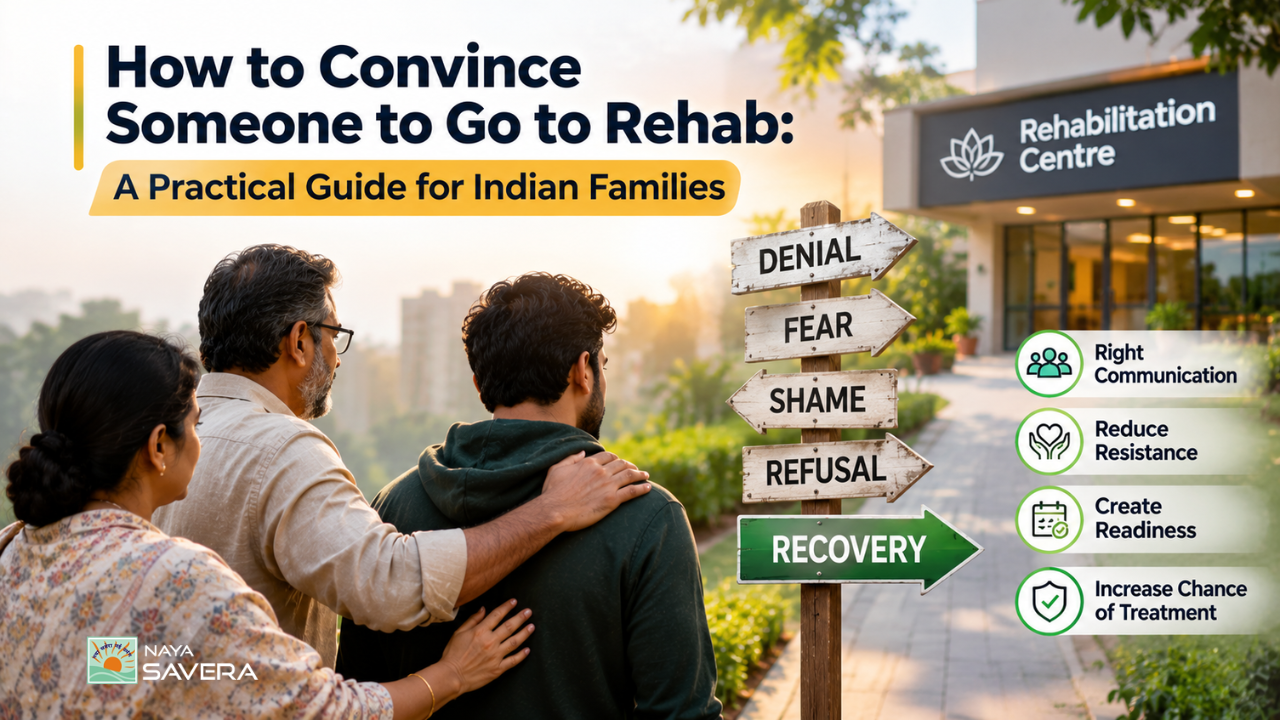

Most families who finally look for a rehab centre have already tried everything else. They have shouted and cried. They have made him swear on his mother’s head. They have hidden bottles, cut off money, taken him to a baba, moved him to a new city, and found him a bride in the hope that marriage would settle him. And every time, after a few good days, the drinking or the drugs came back.
If this sounds like your home, you are not failing. You are using the methods almost every Indian family uses, and they rarely work. The good news is that research shows families have far more influence than they think, when they use the right approach. You may be trying to help an alcoholic who does not want help, or a son hooked on drugs. Either way, this guide explains:
- how to convince someone to go to rehab
- why people refuse
- what to say and what to avoid
- what to do if the answer is still no
Why People Refuse Rehab
Families often call it denial, as if the person simply cannot see the problem. Usually there is more going on. The most common reasons someone refuses rehab are:
- Fear of withdrawal, especially for people who have tried to stop before and felt terribly ill
- Fear of what people will say, at work, in the neighbourhood and in the extended family
- Fear of losing a job, a business or a marriage proposal
- Shame, and the belief that needing help means he is weak
- The belief that he can stop on his own, “from Monday”
- Fear of being locked up or treated badly, often from stories about poorly run centres
- The drink or drug is the only way he knows to cope with stress, grief, anxiety or low mood
Each of these needs a different response. A man afraid of withdrawal needs to hear that detox is done safely under medical care. A man afraid of his reputation needs to hear about confidentiality. Understanding his reason is the first step to answering it. Our piece on why Indian men delay seeking help for addiction explores these fears in more detail.
What Usually Does Not Work
Before trying something new, it helps to stop doing the things that make refusal stronger:
- Shouting and labels. Calling him a sharabi or a nashedi makes him defend himself instead of listening.
- Emotional blackmail and oaths. Promises made under pressure are broken within days, and each broken promise adds to his shame.
- Public shaming. Raising it at a family function or in front of relatives pushes the problem deeper into secrecy.
- Threats you will not carry out. If you say “this is the last time” and it never is, your words lose their weight.
- The ambush intervention. Gathering the whole family to confront him without warning can work in films, but in real life it often ends in anger and a walk out.
- Secret medicines. “Nasha chhudane ki dawa” mixed into food without his knowledge is unregulated, its contents are unknown, and it can be dangerous.
- Rescuing. Paying his debts, calling his boss with excuses and cleaning up after him protects the addiction from its own consequences.
A Better Approach: CRAFT
The most researched method for families is called CRAFT, short for Community Reinforcement and Family Training. It was developed in the United States for families whose loved one refuses help, and it has since been used around the world.
Unlike a traditional addiction intervention, CRAFT does not rely on confrontation. It teaches families to:
- communicate in a way that lowers defensiveness
- make sober time more rewarding than using time
- stop shielding the person from natural consequences
- look after their own wellbeing
- recognise the moments when he is most likely to say yes
The results are striking. In a well-known 1999 study, families using different methods got these results:
| Method | Got their loved one into treatment |
|---|---|
| CRAFT | 64 percent |
| Traditional confrontational intervention | 30 percent |
| Family support group alone | 13 percent |
Later studies found similar results, with most showing that more than half of families using CRAFT succeeded. Family members’ own wellbeing improved too, whether or not their loved one entered treatment.
You do not need a formal course to use its core ideas. The steps below are built on them.
Step by Step: How to Get Someone Into Rehab
1. Look after your own safety first
If drinking or drug use has led to violence or threats, your safety and your children’s safety come before any conversation. Do not try to talk when he is intoxicated or angry. If you are in danger, call 112. The national women’s helpline, 181, can also help.
2. Learn the pattern
Notice when he uses, what sets it off, and when he is most open. Many people are most willing to talk about change at moments like these:
- the morning after a bad night
- after a health scare
- after a fight at work
- after a frightening incident
These are the windows to watch for.
3. Talk to him, not at him
Choose a calm moment when he is sober. Speak about what you have seen and how it affects you, using “I” rather than “you”. Keep it short and specific. Then listen. One calm conversation does more than ten arguments.
4. Make sober time better than using time
Spend time with him when he is sober: a meal he enjoys, a walk, a cricket match on TV, time with the children. When he is drunk or high, calmly withdraw. Do not argue, do not lecture, simply step away. Over time, the contrast becomes hard to ignore.
5. Stop rescuing
Let the natural consequences of his drinking or drug use reach him. Do not lie to his employer, pay off new debts or hide the damage from the rest of the family. This is not cruelty. It is letting reality do some of the persuading.
6. Have the plan ready before you ask
When he finally says “okay, maybe”, that window can close within hours. Before you ask, know which rehab centre you would choose, have spoken to them, and know what the first step will be. Our guide on how to choose a rehab centre in Delhi NCR lists the questions to ask.
7. Offer choices, not ultimatums
People resist being told what to do, but they respond to having a say. Instead of “you are going to rehab”, try “would you rather talk to a counsellor first, or visit the centre with me on Saturday?” Both choices move in the same direction, and he decides which one.
8. If he says no, keep going
A no today is not a no forever. Do not argue or repeat the request every day. Stay calm, keep up the steps above, and ask again at the next good moment. Many people who eventually enter treatment said no several times first.
What to Say, and What Not to Say
Small changes in wording make a big difference.
Instead of “You are a drunk and you have ruined this family”, try “When you came home at 2 am last night, the children were frightened. I miss the person you are when you are not drinking.”
Instead of “Go to rehab or get out of this house”, try “I have found a place that can help. Will you come with me to talk to them?”
Instead of “You never think about us”, try “I am worried about your health, and I want you around for a long time.”
Instead of “Why can’t you just stop?”, try “I know stopping is hard. You do not have to do it alone.”
If you are a wife in this situation, our guide on when your husband drinks every day covers these conversations in more depth.
Bring in the Right People
Sometimes the message lands better from someone else. Choose one or two people he respects and trusts, such as an elder brother, an uncle, a close friend or a family doctor, rather than the whole family. A doctor can be especially persuasive, because blood tests and a frank medical opinion are hard to argue with. Someone who has been through recovery themselves can also reach him in a way family members cannot.
If he is afraid of the physical side of stopping, explain that withdrawal is managed through a medically supervised detox. Our guide to alcohol detox under medical supervision explains why stopping suddenly at home can be dangerous and what a safe detox involves.
When You Should Not Wait
Some situations need help immediately, whether or not he agrees to rehab:
- Signs of overdose, such as being impossible to wake, very slow breathing or blue lips
- Seizures, confusion or seeing things during withdrawal
- Talk of suicide or self-harm
- Violence or serious threats
- Hearing voices, extreme suspicion or behaviour that seems out of touch with reality
In an emergency, call 112 or go to the nearest hospital. For mental health concerns, Tele-MANAS, the government’s free helpline, is available on 14416 or 1-800-891-4416. Depression and anxiety often sit underneath addiction, and our guide to dual diagnosis explains why both need treatment together.
After He Says Yes
Act quickly and keep it simple. Call the rehabilitation centre the same day, arrange the assessment, and help him pack. Reassure him about what comes next. Many families find it helps to read together about what happens in the first 30 days at a rehab centre, because knowing what to expect takes away much of the fear.
Look After Yourself Along the Way
Living with someone’s addiction is exhausting, and you cannot pour from an empty cup. Talk to someone you trust, take breaks, and consider joining a family support group. Al-Anon and Nar-Anon, the 12 step groups for families, are explained in our guide to how the 12 Steps work. Once treatment begins, family counselling gives you a structured place to rebuild trust and prepare for his return home.
How Naya Savera Helps
Naya Savera is a non-profit nasha mukti kendra and de addiction centre treating alcohol and drug addiction. It is registered under the Indian Trust Act and has worked with families since 2008. We run:
- a rehabilitation centre in Delhi
- a nasha mukti kendra in Noida
- a centre in Palampur, Himachal Pradesh
Treatment moves from health assessment and detox through primary care, secondary care and aftercare. Our programme combines the Narcotics Anonymous 12 Steps and a therapeutic community with clinical psychiatry, Ayurveda and yoga, along with 24/7 medical and psychological support. Our counsellors and clinical psychologist provide cognitive behaviour therapy, family and marital therapy and stress management. Families take part through monthly counselling and home visits, and every person leaves with a relapse prevention plan and regular follow ups.
If you are not sure how to start the conversation with someone you love, you can call us for a confidential discussion about your situation.
Frequently Asked Questions
How do I convince someone to go to rehab?
Choose a calm, sober moment, speak about what you have seen and how it affects you, and offer a clear next step rather than an argument. Approaches like CRAFT focus on positive communication, rewarding sober time and letting natural consequences happen, and they get more people into treatment than confrontation does.
What if my family member refuses rehab completely?
Do not give up, and do not argue every day. Keep communicating calmly, stop rescuing him from consequences, look after your own wellbeing and watch for the next moment he is open to change. Many people say no several times before they say yes.
Do interventions work?
Surprise, confrontational interventions get some people into treatment but often end in anger. Research shows that CRAFT, a non-confrontational approach that trains families over time, gets more loved ones into treatment. Families using it also feel better themselves.
Should I give an ultimatum?
Only if you are ready to carry it out. An ultimatum you do not follow through on weakens everything you say afterwards. In most cases, offering choices that all lead towards treatment works better than threats.
Should I wait for him to hit rock bottom?
No. Rock bottom can mean a lost job, a broken marriage, a serious accident or an overdose. The earlier treatment begins, the more of his health, work and relationships there is left to protect. Families can do a great deal to help someone reach that decision sooner.
You do not have to wait until things get worse. Reach out to Naya Savera for a confidential conversation about your family’s situation and the right next step.
Leave a Comment