

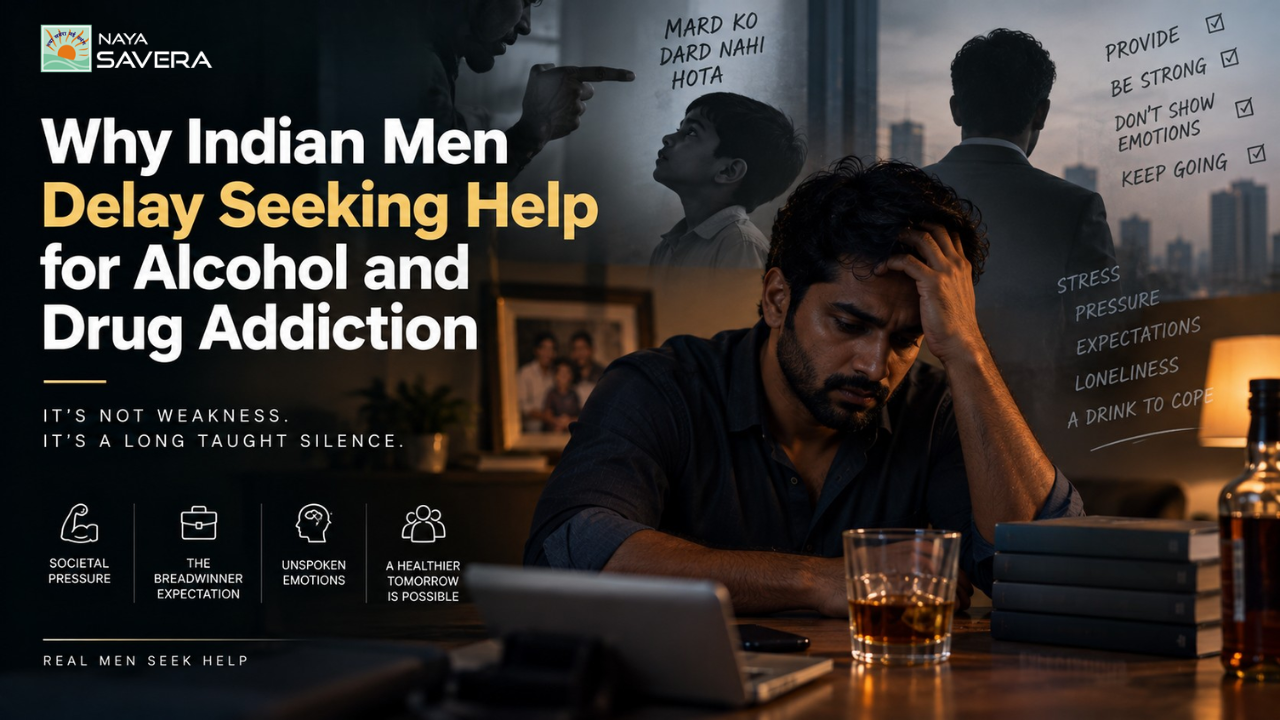

Statistically, men in India are far more likely than women to develop a substance use disorder. And yet, when it comes to actually walking through the door of a treatment centre, the numbers flip, women tend to seek help earlier, while men wait, often for years, sometimes until a crisis leaves them no other option. This gap has very little to do with how serious the problem is and almost everything to do with what men are taught, from childhood, about what it means to struggle.
Understanding this pattern matters enormously for families across Delhi NCR, where alcohol addiction in men continues to be one of the most common, and most delayed, reasons families eventually seek professional help.
The Conditioning That Starts Long Before Addiction Does
Long before a man ever picks up a drink to cope with stress, he has usually already absorbed a very specific lesson, that pain is something to be carried quietly, not spoken about. Phrases like “mard ko dard nahi hota”, men don’t feel pain, get repeated casually throughout childhood, reinforcing the idea that stoicism is strength and vulnerability is weakness. A boy who cries is told to toughen up. A boy who stays composed, even when struggling internally, is praised.
By adulthood, this conditioning has become deeply embedded. Many men have genuinely lost the ability to identify, let alone communicate, what they are actually feeling, not because they lack emotional depth, but because decades of social reinforcement have taught them that expressing it invites judgment rather than support.
The Breadwinner Trap
Layered on top of this emotional conditioning is a second, equally powerful pressure, the expectation that a man’s primary value lies in his ability to provide. In a country where family structures still place enormous weight on a man’s role as protector and provider, admitting to a struggle with addiction can feel less like a personal health issue and more like a failure of identity itself.
This creates a genuinely difficult bind. A man struggling with drug addiction or alcohol dependency often fears that acknowledging the problem, let alone stepping away for treatment, will be read as an inability to fulfil his role as breadwinner, potentially threatening his job, his standing in the family, or how his wife, children and parents view him. Rather than risk that perceived loss of status, many men choose silence, continuing to function, continuing to provide, while the dependency quietly deepens underneath.
Why Alcohol Becomes the Default Coping Mechanism
When emotional expression has been culturally discouraged for decades and professional help carries the risk of being seen as weak, men are frequently left with very few socially acceptable outlets for genuine distress. Alcohol fills this gap in a way that feels, at least initially, both effective and masculine. A drink after a hard day is rarely questioned. A visit to a therapist often is.
Research on men struggling with addiction consistently finds that behaviours like risk taking, aggression, and substance use often substitute for the help seeking behaviour that might otherwise address the underlying distress directly. Alcohol becomes not just a substance but a substitute language, a way of managing pain that never has to be named out loud.
Why Men Wait Until Crisis Point
Because acknowledging addiction requires admitting vulnerability, something men have specifically been trained to avoid, many do not seek treatment until the consequences become impossible to ignore, a health scare, a marriage on the verge of collapse, a job at risk, or intervention forced by concerned family members. By this point, the dependency has often had years to deepen, making recovery from alcohol addiction considerably harder than it would have been with earlier intervention.
This delay is not a personal failing on the part of any individual man. It reflects a broader cultural pattern where seeking help is coded as feminine or weak, and where the systems around men, family, workplace, social circle, rarely create genuine space for a man to say, plainly, that he is struggling.
Signs Families Often Miss in Men Specifically
Because men are more likely to mask distress behind a composed exterior, the usual signs families look for often do not apply in the expected way. A man struggling with dependency may continue performing well at work, remain outwardly calm during family interactions, and actively deflect any direct questions about his drinking with humour or mild irritation rather than visible distress.
Worth watching for instead are patterns such as increasing time spent away from family under vague pretexts, a noticeable reluctance to discuss anything emotionally difficult, physical health complaints that seem to have no clear cause, and a pattern of using alcohol specifically after stressful events, a difficult day at work, a financial setback, a family conflict, rather than purely social occasions.
Why Treatment Needs to Meet Men Where They Are
Effective treatment for men struggling with addiction often needs to account for this specific conditioning directly rather than simply asking a man to “open up” in the way a generic counselling approach might expect. This means creating an environment where seeking help is reframed, not as an admission of weakness, but as an act of responsibility toward the very role, provider, protector, family anchor, that the man has been trying to protect by staying silent in the first place.
Practical concerns around work and financial responsibility also need to be addressed head on rather than dismissed. A man is far more likely to engage with treatment when a counsellor acknowledges upfront that his job and his ability to provide matter, and works with him to build a treatment plan that protects both his recovery and his professional standing, rather than treating these concerns as excuses to be pushed past. Naya Savera has applied exactly this approach with working professionals managing addiction alongside genuine career pressure, including men navigating high stakes corporate environments in Gurugram’s demanding business districts, where the fear of professional consequence is often the single biggest barrier to seeking care.
What Families Can Do Differently
If you are concerned about a man in your life, whether a husband, father, brother or son, avoid framing the conversation around weakness or failure, language that will almost certainly trigger defensiveness given a lifetime of conditioning against exactly that framing. Instead, approach the conversation from a place of genuine concern for his wellbeing, and consider explicitly naming that seeking help is a sign of strength and responsibility, not its opposite, since this reframing directly counters decades of cultural messaging he has likely internalized.
Patience matters considerably here. A man who has spent his entire life learning not to ask for help will rarely do so after a single conversation. Consistent, non judgmental support, paired with a clear, practical path toward professional treatment that respects his concerns about work and family responsibility, tends to be far more effective than pressure or ultimatums.
Frequently Asked Questions
Why do men wait longer than women to seek addiction treatment, even though addiction rates are higher among men?
Cultural conditioning around masculinity, stoicism and self reliance discourages men from acknowledging vulnerability, which delays help seeking considerably compared to women, who research suggests tend to seek treatment earlier.
Is a man’s calm, composed exterior a reliable sign that he doesn’t have a drinking problem?
No. Men are more likely to mask distress behind outward composure specifically because vulnerability has been culturally discouraged, meaning a composed exterior often hides rather than reflects the actual severity of a dependency.
How does concern about work and financial responsibility affect men seeking treatment?
Many men delay or avoid treatment specifically out of fear that stepping away will threaten their job or their ability to provide for their family, which is why effective treatment plans need to directly address these practical concerns rather than dismiss them.
What’s the most effective way to encourage a man to seek help without triggering defensiveness?
Reframing help seeking as an act of strength and responsibility, rather than weakness, tends to be far more effective than direct confrontation, along with patience and consistent, non judgmental support over time.
Does Naya Savera have experience specifically working with men managing career pressure alongside addiction?
Yes, our team regularly works with professional men who are concerned about how treatment will affect their careers, building treatment plans that protect both recovery and professional standing.
Breaking a Pattern That Has Cost Too Much Silence
The gap between how common addiction is among Indian men and how long they wait to seek treatment reflects a cultural pattern decades in the making, not a personal weakness in any individual man. Naming this pattern clearly, and building treatment approaches that genuinely account for it, is essential to closing that gap.
If a man in your life is struggling, a confidential, judgment free conversation with a professional treatment provider is a reasonable next step, not a threat to his role as provider or protector. Naya Savera has supported men across Delhi, Noida and the wider NCR region since 2008, with an approach built to work with, not against, the pressures men carry.
1 Comment