

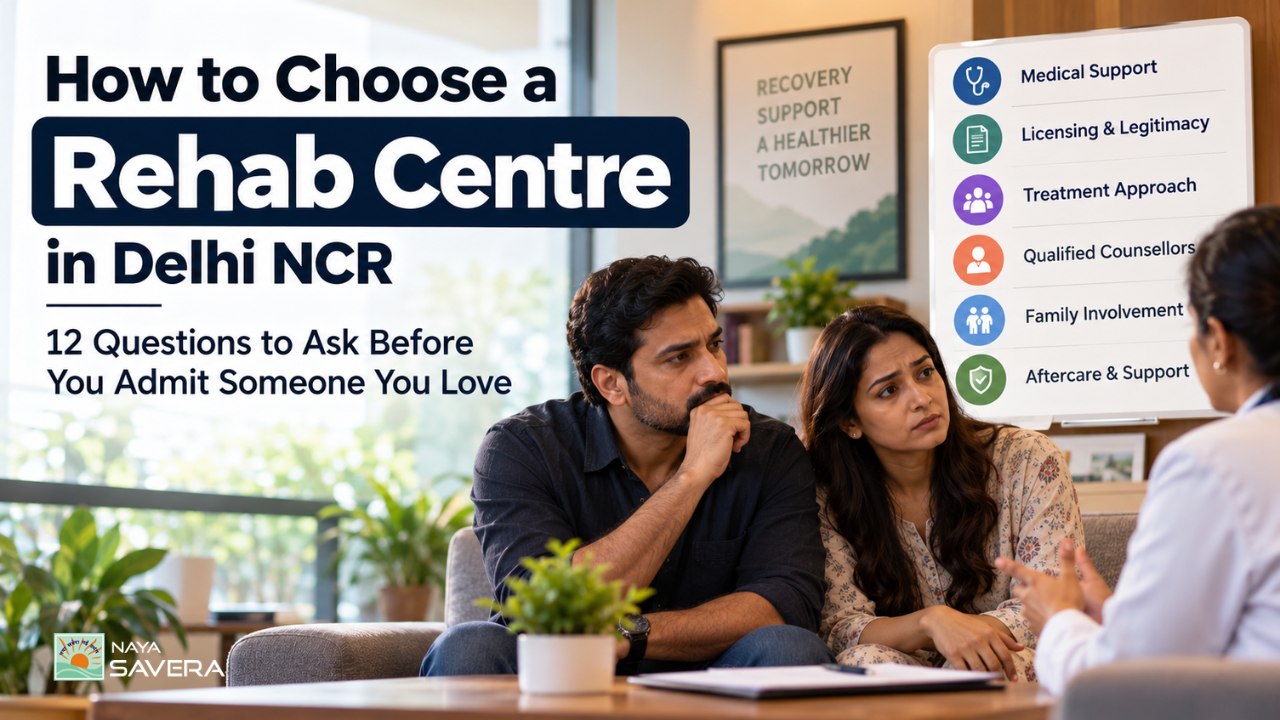

Most families choose a rehab centre in a hurry. There has been a crisis, a relative has finally agreed to go, and the window may close by tomorrow. So someone searches “best rehab centre near me,” calls the first three numbers, and picks whichever one answers the phone with confidence. Sometimes that works out. Too often it does not, because the question families ask is “who can take him today” when the question that matters is “who will actually get him well.”
This guide is for the family standing at that point. It explains what separates a genuine rehabilitation centre from a locked building with beds, which questions to ask on the first call, what to look for when you visit, and the red flags that should end the conversation. It applies whether you are looking for a rehab centre in Delhi NCR, Noida, Gurugram or anywhere else in the region.
Why “Best” Is the Wrong Word
There is no single best centre. There is the right centre for this person, with this substance, at this stage, with this family. A centre that is excellent for a 45 year old businessman with twenty years of daily drinking may be wrong for a 19 year old using synthetic drugs for eight months. The first thing a good centre does on the phone is ask about the person. If they instead start by telling you about their facilities and their packages, note that.
Start With the Medical Basics
Addiction treatment begins with the body, and the body can be in real danger during the first week.
Ask whether there is a doctor on site or on call every day, and whether a psychiatrist is available. Alcohol withdrawal can cause seizures. Opioid withdrawal and sedative withdrawal need medication to be safe and bearable. A centre that cannot describe its medical detox protocol in plain language, or that says detox is handled “naturally” with no medical supervision, is not a treatment centre. It is a hostel.
Ask what happens in a medical emergency. Which hospital, how far, who decides. A centre that has never needed to answer this question has either been lucky or is not telling you the truth.
Ask whether they test for and treat the conditions that travel with addiction: liver and kidney function, hepatitis and HIV in injecting patients, and the depression and anxiety that very often sit underneath the substance use. If the answer is that they focus only on the addiction, the person will leave with half their problem untreated.
Check Licensing and Legitimacy
India has a real problem with unregulated centres. Every year there are news reports of facilities that were nothing more than locked rooms, where patients were confined, beaten or neglected, usually by people with no medical or counselling training. Families chose them because the price was low and the promises were confident.
Ask directly whether the centre is registered under the Mental Healthcare Act with the State Mental Health Authority, and ask to see the registration. Ask about the organisation behind the centre, whether it is a registered trust, society or company, and how long it has operated. A licensed rehabilitation centre will answer these questions easily, because it is asked them often. Evasion, irritation, or “do not worry about all that” is a reason to hang up.
Understand the Treatment, Not the Facility
Photographs of lawns and air conditioned rooms tell you nothing about whether anyone gets better there. Ask what a patient’s day actually looks like. A real drug and alcohol rehabilitation programme has a structure: morning routine, individual counselling, group sessions, education about the condition, physical activity, rest, and an evening wind down. If the answer is vague, the days are probably empty, and empty days are where relapse plans are made.
Ask who does the counselling and what their qualifications are. Addiction counselling is a skill, not a kindness. Recovered patients can be valuable members of a team, but a programme run entirely by people whose only credential is their own recovery is missing the clinical layer that difficult cases need.
Ask how the treatment plan is made. The right answer is that it is built for the individual after assessment, not applied from a template. Ask how long the programme is and how that length is decided. A fixed number of days quoted before anyone has met the patient is a package, not a plan.
If you are not sure what a proper first month should contain, our guide to what happens in the first 30 days at a rehab centre describes the structure a genuine programme follows, and it gives you something to compare each centre’s answers against.
Ask About the Family’s Role
Addiction grows inside a household, and recovery has to be rebuilt there too. A serious centre involves the family from the beginning. Ask whether there are family counselling sessions, how often, and whether they continue after discharge. Ask what the contact policy is in the first weeks, when you can speak to the person, and how you will be updated on their progress. A centre that treats the family as an inconvenience, or that goes silent once the admission fee is paid, is a centre you will regret.
Visit, and Look at the Right Things
Never admit someone to a centre you have not seen. When you visit, look past the reception area. Ask to see the rooms where patients actually sleep, the bathrooms, the kitchen and the space where group sessions happen. Notice whether current patients look rested and engaged or sedated and idle. Notice how staff speak to them. Ask whether doors are locked and why.
Ask the question nobody likes to ask: is any form of physical discipline or forced confinement used. The only acceptable answer is no. A centre that justifies “strictness” as part of treatment is describing abuse.
Get Clarity on Cost
Ask for the full monthly cost in writing and what it includes: accommodation, food, medicines, doctor consultations, counselling, and any tests. Ask what is charged separately. Ask what happens financially if the person leaves early or needs to stay longer. Hidden charges that appear in week three are common, and they tend to appear exactly when the family has the least ability to walk away.
Do not choose on price alone in either direction. The cheapest centres are often the unregulated ones. The most expensive are not automatically better; a luxury facility with weak clinical staff is an expensive hostel. A non-profit de addiction centre run as a trust will usually sit between the two and will be able to explain exactly where the money goes.
Ask What Happens After Discharge
The first ninety days at home carry the highest relapse risk, and a centre that disappears at the gate has done half the job. Ask about aftercare: scheduled follow up sessions, a written relapse prevention plan, what to do if the family notices warning signs, and the policy on readmission. A good centre will say that readmission is part of treatment, not a failure of it, and will have a clear process.
Read the Reviews Properly
Rehab centre reviews on Google are useful if you read them the right way. Look for specifics: a family member describing the counselling, the detox, the way staff handled a difficult week. Ignore the five star reviews that say nothing but “good centre.” Be suspicious of a cluster of reviews posted on the same day, and of a profile with hundreds of reviews and no critical ones at all. Read the two and three star reviews most carefully, because that is where you find out how the centre behaves when something goes wrong. If you are looking on the Gurugram side of NCR, our note on choosing de-addiction support for Gurugram families covers the local picture.
The 12 Questions
- Is a doctor on site or on call daily, and is a psychiatrist available?
- What is your medical detox protocol?
- What happens in a medical emergency, and which hospital do you use?
- Are you registered under the Mental Healthcare Act? Can I see it?
- Who runs the organisation and how long has it operated?
- What does a patient’s day look like, hour by hour?
- Who does the counselling and what are their qualifications?
- How is the treatment plan made, and how is the length decided?
- How is the family involved, during and after treatment?
- What is the full cost, in writing, and what is excluded?
- Is any physical discipline or forced confinement ever used?
- What aftercare is provided, and what is your readmission policy?
Red Flags That Should End the Call
A guaranteed cure or a guaranteed timeline. A refusal to let you visit before admission. No doctor, or vague answers about who the doctor is. No registration they are willing to show. Pressure to admit today with a discount that expires tomorrow. Silence on family involvement. Any hint that “strictness” or confinement is part of the method. And an offer to pick the person up from home without their knowledge or consent, which is both illegal and the surest way to produce a patient who leaves on day three.
One More Thing: The Person Has to Be Part of This
The right centre also knows how to help a reluctant patient agree to come. If your relative is refusing, ask the centre how they handle that. We have written about why men in particular delay seeking help; a good centre will offer to speak to the family first, help plan the conversation, and guide an intervention rather than simply tell you to “bring him in.”
How Naya Savera Answers These Questions
Naya Savera is a non-profit trust that has run de-addiction and rehabilitation programmes since 2008, with facilities in Delhi, Noida and Himachal Pradesh. Medically supervised detox runs with daily doctor review. Treatment plans are built after an individual assessment, and the daily programme combines structured addiction counselling, group work, physical activity and rest. Families are involved from the first week, with a clear contact schedule and sessions that continue after discharge. Costs are explained in full before admission. Nobody is confined or disciplined physically, and nobody is admitted without their own agreement; where a family needs help reaching that point, we help plan the conversation. As a nasha mukti kendra that families across Delhi NCR have trusted for nearly two decades, we would rather you ask every question on this list than choose us without asking any of them.
Frequently Asked Questions
How do I know if a rehab centre is legitimate?
Ask whether it is registered under the Mental Healthcare Act with the State Mental Health Authority and ask to see the registration. Ask about the organisation behind it and how long it has operated. Visit before admitting anyone. A legitimate centre answers all of this easily.
Is a more expensive rehab centre better?
Not necessarily. Price reflects facilities more than clinical quality. Judge a centre by its medical supervision, the qualifications of its counsellors, the structure of its programme and its family involvement, not by its lawns.
Can I admit my family member without their consent?
Indian law generally requires the person’s consent. A reputable centre will help the family plan a conversation or intervention so that the person agrees to treatment. Be wary of any centre that offers to pick someone up without their knowledge.
How long should a rehab programme be?
It depends on the substance, the severity and how the person responds. Be cautious of a fixed duration quoted before anyone has assessed the patient. A good centre decides length after assessment and reviews it with the family.
What should I check when I visit a centre?
The rooms where patients sleep, the bathrooms, the kitchen, the group session space, how staff speak to patients, whether doors are locked and why, and whether current patients look engaged rather than sedated or idle.
If you are at the point of choosing, take an hour to ask these questions before you take the decision. Reach out to Naya Savera for a confidential conversation, and ask us all twelve.
Leave a Comment