

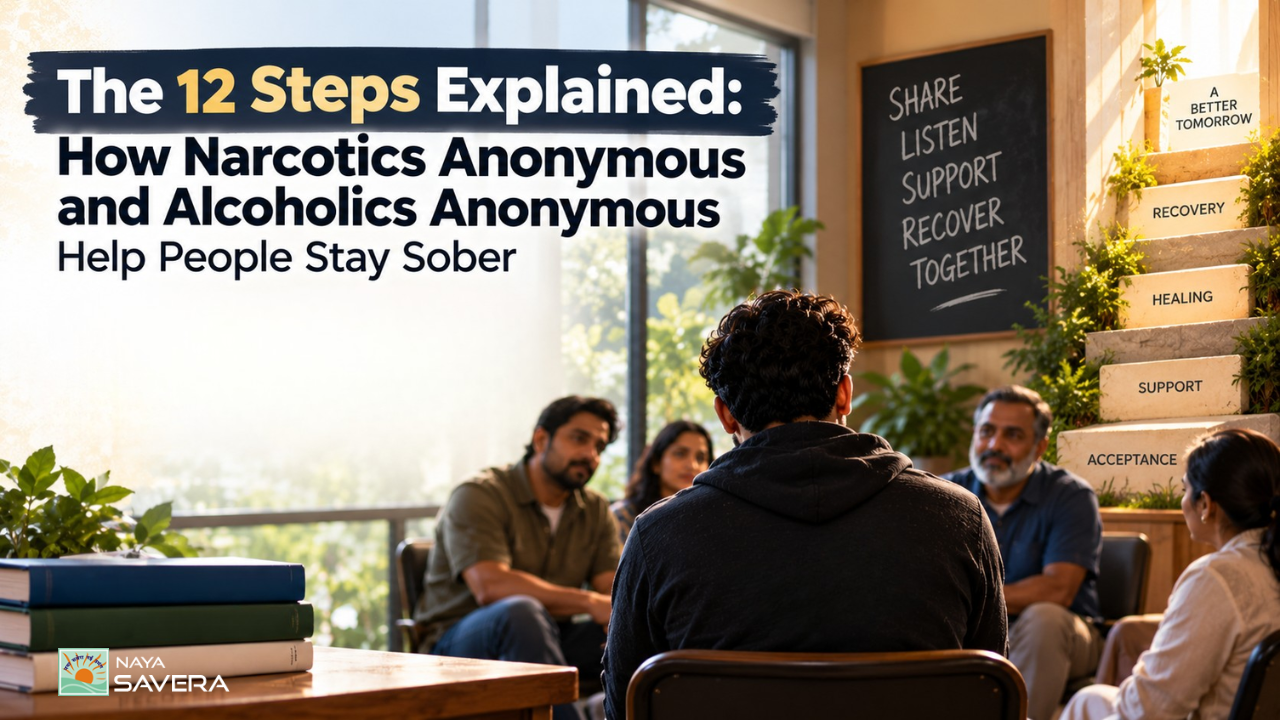

Most families first hear about the 12 Steps when someone they love enters rehab. A son comes home from his first family visit and talks about “working Step 1”. A husband mentions his sponsor. Someone says “one day at a time” as if it were a rule for life. To the family it can sound like a club with its own language, or worse, like something religious they did not sign up for.
The 12 step programme is one of the most widely used approaches to recovery from addiction in the world, and it sits at the heart of how many Indian rehab centres work. This guide explains:
- what the 12 Steps actually are
- how Narcotics Anonymous and Alcoholics Anonymous meetings run
- what the research says
- how families can support the process instead of feeling shut out of it
Where the 12 Steps Come From
Alcoholics Anonymous, or AA, began in the United States in 1935. Two men struggling with drinking found that talking openly with each other helped them stay sober in a way nothing else had, and they wrote down what had worked for them as twelve steps. Narcotics Anonymous, or NA, followed in the 1950s and adapted the same steps for people addicted to drugs.
Today AA and NA meetings run in cities across India, including across Delhi NCR, in English, Hindi and other languages. Membership is free. There are no fees, no forms and no need to give your full name. The only requirement for membership is a desire to stop drinking or using.
The 12 Steps in Plain Language
The official wording of the steps belongs to AA and NA, and is read out at most meetings. In everyday language, the 12 steps of recovery fall into four stages.
Honesty and Acceptance: Steps 1 to 3
The person admits that alcohol or drugs have taken control and that life has become unmanageable. They come to believe that help from outside themselves can restore them. They decide to accept that help instead of relying only on willpower.
Looking Inward: Steps 4 to 7
The person makes an honest inventory of their life: resentments, fears, the harm they have done, and the patterns that kept the addiction going. They share it with one trusted person. Then they work on letting go of the habits and defects that drove the using.
Repairing Relationships: Steps 8 and 9
They make a list of the people they have hurt and, where it will not cause further harm, make amends. For many Indian families, this is the step where a parent hears a real apology for the first time in years.
Living It Every Day: Steps 10 to 12
Recovery becomes a daily practice. The person keeps checking their own behaviour, admits mistakes quickly, uses prayer or meditation to stay grounded, and helps others who are still struggling.
The steps are not a course to be finished in a month. People return to them again and again, often for the rest of their lives.
“Is It Religious?” The Question Every Family Asks
The steps talk about a “Higher Power” and use the word God, which worries many families. In practice, the 12 Steps are spiritual rather than religious. Each member is free to understand the Higher Power in their own way. For some it is God as they already worship, whether Hindu, Muslim, Sikh or Christian. For others it is the group itself, the idea of conscience, or simply something larger than their own addiction.
Nobody at a meeting is asked to change their religion, follow a ritual or believe anything specific. What the steps ask for is humility: accepting that the person’s own thinking, on its own, has not been able to solve the problem.
How a Meeting Actually Works
AA meetings and NA meetings follow a simple format and usually last about an hour:
- Someone opens the meeting and a few readings are shared.
- Members take turns speaking about their experience, their struggles and what is helping.
- Nobody interrupts, gives advice or argues.
Some meetings are open to family members and anyone interested. Closed meetings are only for people who want to stop drinking or using.
Three ideas run through every meeting:
- Anonymity. What is said in the room stays there. People use first names only, which matters a great deal in Indian families where stigma keeps so many people silent.
- Sponsorship. A newer member chooses a sponsor, someone with longer recovery who guides them through the steps and is available when cravings or crises hit.
- One day at a time. Instead of promising never to drink or use again, members focus on staying sober today. A lifetime feels impossible; today feels manageable.
For many people, the first meeting is the first time they have heard someone else describe their own secret life out loud. That moment of recognition often does more than months of family pleading.
What the Research Says
The 12 Steps have sometimes been dismissed as old-fashioned or unscientific. The evidence says otherwise. A 2020 Cochrane review, one of the most rigorous types of medical research, pooled 27 studies involving more than 10,000 people with alcohol problems. It found that well-structured AA and twelve-step programmes helped more people stay continuously sober for a year than other established treatments, and that the benefit held at two and three years.
That does not mean the steps work for everyone, or that they replace medical care. The strongest results come when 12 step programmes are part of a wider plan that includes medical detox, counselling, family involvement and treatment of any mental health condition. If you want to understand why that wider plan matters, our guide to dual diagnosis explains how depression and anxiety interact with addiction.
The 12 Steps and Medicines
Families sometimes hear that people in the 12 Steps should not take any medicine at all. This is a misunderstanding. AA and NA are clear that their members are not doctors and should not give medical advice. A doctor may prescribe and monitor medicines for depression, anxiety, sleep, or recovery from opioid or alcohol addiction, and that is a medical decision. What the programme warns against is using pills to get high or to escape feelings, which is a risk worth taking seriously. Our piece on prescription drug misuse in India explains how easily that line is crossed.
The 12 Steps Inside Rehab: The Therapeutic Community
In a residential rehabilitation centre, the 12 Steps are usually combined with a therapeutic community. Residents live together under a clear structure, and the community itself becomes part of the treatment:
- Everyone has responsibilities in the daily running of the house.
- Residents give each other honest feedback and take part in group sessions.
- They earn trust and privileges by showing change over time.
The two work well together. The steps give the person a framework for honesty and change. The community gives them a place to practise it every day, with people who will notice and say something if old patterns return. If you want to know what this looks like in the early weeks, read what actually happens in the first 30 days at a rehab centre.
The steps are just as useful for drugs as for alcohol. People recovering from heroin, cannabis, pills and stimulants all work the same steps, and NA meetings welcome anyone with any drug problem. Our guide on smack and heroin addiction explains why long term support matters so much for opioid recovery in particular.
Why Meetings Matter Most After Rehab
The real test of recovery begins when a person comes home. The structure of rehab is gone, old friends call, stress returns and the family is still healing. This is where 12 step meetings make the biggest difference. A person who goes to regular meetings in their own city has a ready-made support network, a sponsor to call at midnight, and a weekly reminder of where they came from.
Families can help in two ways:
- Treat meetings as a priority rather than an inconvenience.
- Do not push for an early return to every social obligation, especially weddings and parties where drinking is everywhere.
Our piece on why relapse happens after rehab explains what families can do in the first 90 days home.
Support for Families: Al-Anon and Nar-Anon
Addiction affects the whole family, and families have their own 12 step groups. Al-Anon is for families and friends of people who drink, and Nar-Anon is for families of people who use drugs. Members are parents, wives, husbands and children who have lived through the same lies, fear and exhaustion.
These groups do not teach families how to make someone stop. They help family members:
- stop living their whole lives around the addiction
- look after their own health
- respond to the person with love, without rescuing them from every consequence
If you are a wife living with daily drinking, our guide on when your husband drinks every day is a good place to start alongside these groups.
Within the rehab programme itself, family counselling helps rebuild trust and agree on clear boundaries before the person comes home.
How Naya Savera Uses the 12 Steps
Naya Savera is a non-profit nasha mukti kendra and de addiction centre, registered under the Indian Trust Act and working with families since 2008. Our programme is built on the Narcotics Anonymous 12 Steps and the therapeutic community approach. We combine these with clinical psychiatry, Ayurveda and yoga, and 24/7 medical and psychological support. Treatment moves from health assessment and detox through primary care, secondary care and aftercare.
Our counsellors and clinical psychologist provide cognitive behaviour therapy, family and marital therapy and stress management. Families take part through monthly counselling and home visits. Every person leaves with a relapse prevention plan, regular follow ups and a connection to AA or NA meetings, so that recovery continues long after the stay ends.
We run:
- a rehabilitation centre in Delhi
- a nasha mukti kendra in Noida
- a centre in Palampur, Himachal Pradesh
You can read more on our approach and accreditation page.
Frequently Asked Questions
What is the 12 step programme?
The 12 step programme is a set of guiding principles for recovery from addiction. Alcoholics Anonymous first wrote it in the 1930s, and Narcotics Anonymous later adapted it. It helps people admit the problem, take a hard look at their lives, repair relationships and build a daily practice that keeps them sober.
Is the 12 step programme religious?
No. It is spiritual rather than religious. Members can understand the “Higher Power” in their own way, whether as God in their own faith, the support of the group, or their conscience. Nobody is asked to follow a particular religion.
What is the difference between AA and NA?
Alcoholics Anonymous is for people with a drinking problem, while Narcotics Anonymous is for people with any drug problem, including alcohol. Both follow the same 12 Steps and meeting format, and both are free to join.
Do 12 step programmes actually work?
Research suggests they do. A 2020 Cochrane review of 27 studies found that structured AA and twelve-step programmes helped more people stay continuously sober for a year than other established treatments. They are most effective as part of a complete treatment plan with medical care, counselling and family support.
Can family members attend 12 step meetings?
Family members can attend open AA and NA meetings to understand recovery better. Families also have their own groups, where they can find support for themselves: Al-Anon for families of people who drink, and Nar-Anon for families of people who use drugs.
If someone you love is ready to begin recovery, or you are not sure where to start, reach out to Naya Savera for a confidential conversation about how the 12 Steps, the therapeutic community and medical care can work together for your family.
Leave a Comment