


There is a moment that comes in almost every family dealing with heavy drinking. Someone finally says enough. The bottles are poured down the sink, the person promises that tomorrow will be different, and the family feels, for the first time in months, a little hope. Then, a day or two later, the hands start shaking. Sleep disappears. There is sweating, panic, a racing heart, and sometimes worse. Most families have no idea that what they are watching is not weakness. It is alcohol withdrawal, and for a person who has been drinking heavily every day, it can be a medical emergency.
This guide explains why a person who drinks heavily should never stop drinking suddenly without medical advice, what medically supervised alcohol detox actually involves, what should happen if something goes wrong during detox, and the questions every family in Delhi NCR should ask a rehab centre about medical care, cost and privacy before admitting someone they love.
Why Stopping Alcohol Suddenly Can Be Dangerous
Alcohol is a depressant. It slows the brain down. When someone drinks heavily every day for months or years, the brain adapts by running in a permanently over alert state to compensate. While the alcohol keeps coming, the two forces balance each other. Take the alcohol away overnight and the brain is left running at full speed with nothing holding it back.
That is what withdrawal is. It is not a lack of willpower and it is not drama. It is a nervous system that has been rewired by alcohol suddenly losing the substance it has learned to depend on.
For people who drink occasionally, stopping causes nothing more than a bad day. For daily heavy drinkers, the picture is very different, and it tends to unfold on a predictable timeline.
The Alcohol Withdrawal Timeline
Within 6 to 24 hours of the last drink, the early alcohol withdrawal symptoms begin: shaking hands, sweating, anxiety, irritability, nausea, headache, a fast heartbeat and difficulty sleeping. Many daily drinkers know these symptoms well, because they are exactly what the morning drink was quietly treating.
Between 12 and 48 hours, the risk of withdrawal seizures rises. A seizure can happen without any warning, in someone who has never had one before.
Between 48 and 96 hours, a minority of people develop delirium tremens, commonly cited at around 3 to 5 percent of those in withdrawal. This involves severe confusion, hallucinations, high fever, dangerous swings in blood pressure and heart rate, and it can be fatal without prompt medical treatment.
Symptoms such as poor sleep, anxiety and low mood can then linger for weeks, which is one reason the period after detox needs structured support of its own.
Who Is at Higher Risk
Not every heavy drinker will develop severe withdrawal, but certain factors raise the risk considerably. Daily drinking over a long period. Large quantities each day. Morning drinking to stop the shakes. Any previous withdrawal seizure or episode of delirium tremens. Liver disease or other serious medical conditions. Older age. And use of sleeping pills, anxiety medicines or other sedatives alongside alcohol, a combination we discussed in our piece on prescription drug misuse in India.
There is also something clinicians call kindling. Each time a heavy drinker goes through withdrawal without proper treatment, the next withdrawal tends to be worse. The man who stops “cold turkey” every few months and starts again is often making each attempt more dangerous than the last.
Why Home Detox Is Risky for Heavy Drinkers
Families often try alcohol detox at home, sometimes with medicines bought from a chemist on a relative’s advice. The intention is good. The problem is that nobody at home is trained to recognise a seizure coming, to read a dangerous pulse or blood pressure, to judge when confusion has turned into delirium, or to adjust medication safely hour by hour. By the time a family realises something is seriously wrong, the person may already need emergency care.
This does not mean every person who drinks must be admitted to stop. It means that anyone who drinks heavily and daily should speak to a doctor before stopping, and that for many of them, detox is safest under direct medical supervision.
What Medically Supervised Detox Actually Means
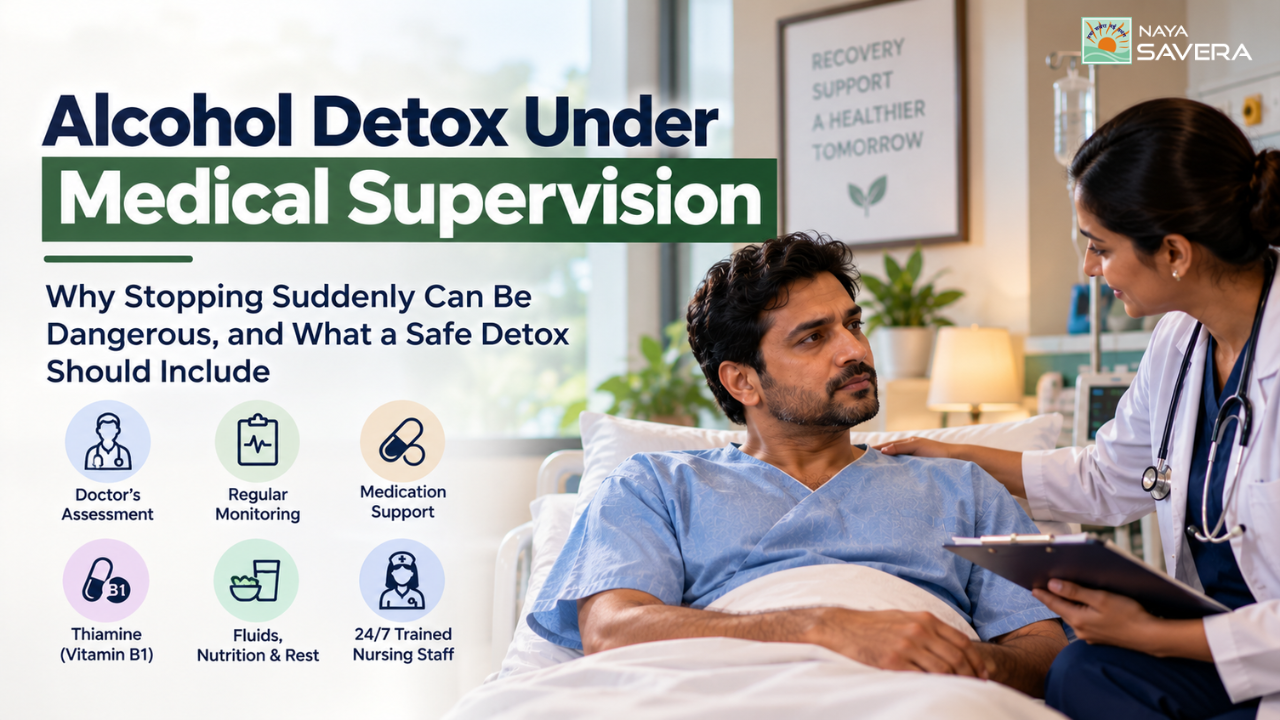
The phrase gets used loosely, so it is worth being specific. A genuine medical detox programme for alcohol should include the following.
A doctor’s assessment before detox begins, covering drinking history, previous withdrawals, current medicines and general health, along with basic blood tests such as liver function where needed.
Regular monitoring through the first days, usually using a structured withdrawal scale that tracks tremor, sweating, anxiety, agitation, orientation and vital signs, so that treatment is guided by measurement rather than guesswork.
Medication to keep withdrawal safe and bearable, prescribed and adjusted by a doctor, and tapered down as the body stabilises.
Thiamine, or vitamin B1, which heavy drinkers are often deficient in. Giving it early helps protect against a serious brain complication called Wernicke’s encephalopathy.
Fluids, nutrition and rest, because most heavy drinkers arrive dehydrated, undernourished and exhausted.
Trained nursing staff available around the clock, because withdrawal does not keep office hours and most complications appear at night.
Detox usually takes around five to seven days, although it varies from person to person. It is the doorway into treatment, not the treatment itself. What follows is described in our guide to what happens in the first 30 days at a rehab centre.
What Should Happen in an Emergency
Even with careful monitoring, a small number of patients will need emergency hospital transfer during detox, whether because of a seizure, severe delirium, a heart rhythm problem or complications from liver disease. A responsible centre plans for this before it happens. Families should expect a clear answer to three questions: which hospital patients are transferred to, how quickly that transfer can happen, and who makes the decision. A centre that has an arrangement with a nearby hospital and ambulance access is prepared. A centre that answers vaguely, or has never thought about it, is not.
Questions to Ask Any Rehab Centre About Detox, Cost and Privacy
Families comparing centres in Delhi, Noida and Gurugram often focus on photographs of rooms and lawns. These are the questions that matter more.
On medical care: Is alcohol detox conducted under direct medical supervision? Is a doctor on site or on call every day, and is a psychiatrist available? Is nursing available around the clock? Which withdrawal monitoring is used? Which hospital do you transfer to in an emergency, and is ambulance support available?
On cost: What is the full rehab centre cost per month, and what does it include, such as medicines, doctor visits, tests, counselling and food? What is charged separately? What happens financially if the stay is shorter or longer than planned? A trustworthy centre will put this in writing before admission.
On privacy: How is patient confidentiality protected? Who in the family receives updates? Will anything be shared with an employer? In India, the Mental Healthcare Act, 2017 covers mental conditions associated with alcohol and drug use and gives people receiving care a right to confidentiality, so a centre should be able to explain clearly how it protects that right.
On legitimacy: Is the centre registered as required under the Mental Healthcare Act? Who runs it, and for how long? Can the family visit before admission?
For working professionals, privacy is often the single biggest reason treatment gets delayed, as we explored in our post on high functioning alcohol addiction among working professionals.
Signs That Withdrawal Needs Urgent Medical Help
If someone has stopped drinking and shows any of the following, call 112 or 108, or go to the nearest emergency department without delay: a seizure or fit, confusion about where they are or who people are, seeing or hearing things that are not there, high fever, a very fast or irregular heartbeat, severe vomiting, or extreme agitation. Do not try to manage these at home, and do not give the person alcohol to “settle them down” without medical advice.
Why Men in Particular Avoid Detox Until It Is Too Late
Many of the men we see delayed treatment for years, not because they did not know they had a problem, but because admitting it felt like failure, and because they assumed they could stop on their own whenever they chose. Our piece on why Indian men delay seeking help explores this in depth. The tragedy is that repeated attempts to quit cold turkey, without medical support, often make each withdrawal more dangerous than the one before.
How Naya Savera Approaches Alcohol Detox
Naya Savera is a non-profit alcohol de addiction centre and nasha mukti kendra, registered under the Indian Trust Act and working with families since 2008, with facilities in Delhi, Noida and Himachal Pradesh.
Every admission is handled with strict confidentiality. Information about a patient is shared only with the family members the patient and family agree on, and nothing is disclosed to employers or anyone else. After detox, treatment continues with structured alcohol addiction treatment, counselling, family sessions and a written relapse prevention plan, because a safe detox is only the beginning of recovery.
Frequently Asked Questions
Is it dangerous to stop drinking alcohol suddenly?
For people who drink heavily every day, yes, it can be. Sudden withdrawal can cause seizures and, in some cases, delirium tremens, which can be fatal without treatment. Anyone who drinks heavily and daily should speak to a doctor before stopping.
How long does alcohol detox take?
Medically supervised alcohol detox usually takes about five to seven days, depending on how much and how long the person has been drinking and their general health. Some symptoms such as poor sleep and anxiety can last longer.
What does medically supervised alcohol detox include?
A doctor’s assessment, regular monitoring of withdrawal symptoms and vital signs, medication adjusted by a doctor, thiamine to protect the brain, fluids and nutrition, round the clock nursing, and a clear plan for hospital transfer in an emergency.
Can alcohol detox be done safely at home?
For mild drinkers, a doctor may advise managing it as an outpatient. For heavy daily drinkers, people with previous seizures or delirium tremens, liver disease or other medical conditions, detox is far safer under direct medical supervision.
Will my family member’s treatment be kept confidential?
It should be. The Mental Healthcare Act, 2017 gives people receiving mental health care, including treatment for alcohol and drug use, a right to confidentiality. Ask any centre to explain exactly how patient information is protected before admission.
If someone you love drinks heavily every day and wants to stop, do not let them stop alone and do not let them stop suddenly without medical advice. Reach out to Naya Savera for a confidential conversation about a safe, medically supervised detox and what comes after it.
Leave a Comment