

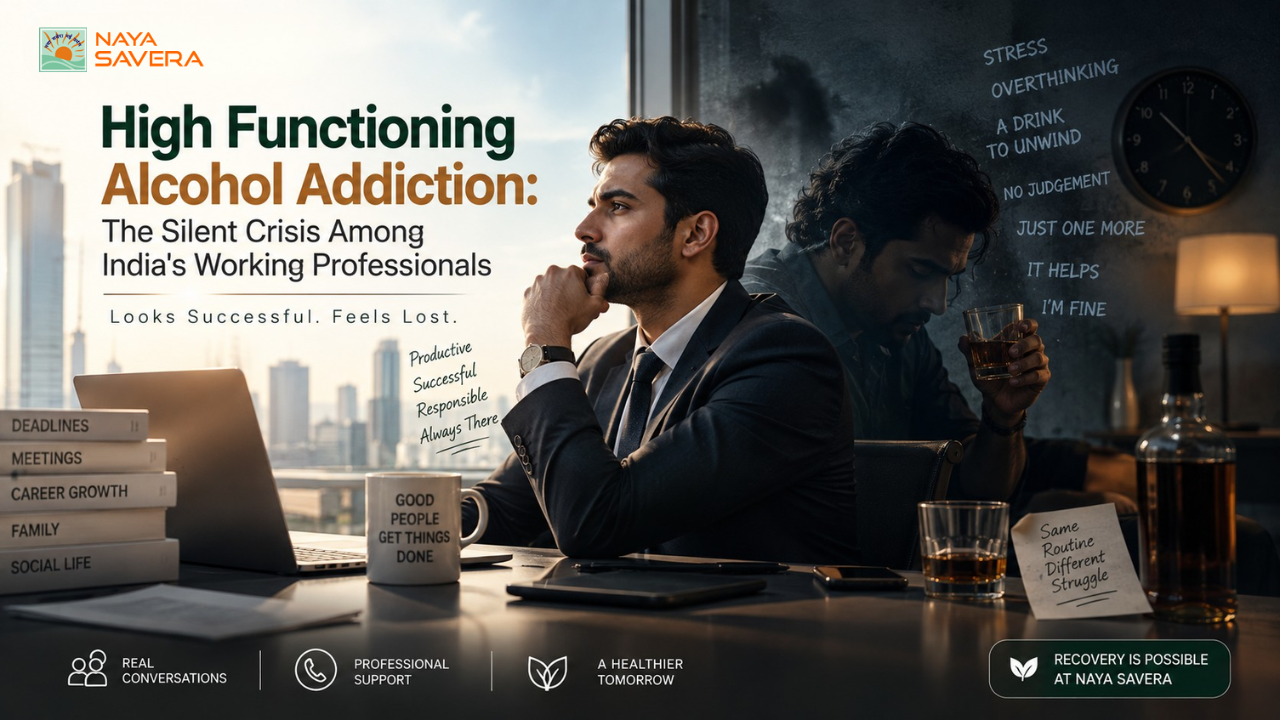

There is a version of addiction that rarely makes it into public conversation, mainly because it doesn’t look like addiction at all. No missed meetings. No visible decline. No dramatic rock bottom moment that forces a family to intervene. Just a person who shows up every day, performs well, meets deadlines, and quietly cannot get through an evening without a drink.
This is high functioning alcohol addiction, and according to recent addiction data coming out of India in 2026, it is one of the fastest growing patterns among the country’s working population. Unlike the stereotypical image most people carry of what alcoholism looks like, this version hides in plain sight, dressed in office formals, holding down a job, raising a family, and never once triggering the kind of alarm bells that usually prompt someone to seek help.
What Exactly Is High Functioning Alcohol Addiction
The term describes someone who continues to meet their professional and social obligations, sometimes exceptionally well, while privately struggling with a genuine dependency on alcohol. They are not the person stumbling out of a bar at 2 AM. They are the colleague who never misses a deadline, the manager everyone respects, the parent who shows up to every school event, all while structuring their entire day around when and how much they can drink without anyone noticing.
This is precisely what makes it so dangerous. Because outward success masks the problem so effectively, both the person struggling and the people around them often dismiss early warning signs. A drink after a stressful call becomes a drink every evening. A glass of wine to unwind becomes something that has to happen for the evening to feel normal at all.
Why This Pattern Is Rising Specifically in India
A few factors unique to India’s current professional landscape are accelerating this trend. Corporate work culture, particularly in sectors like IT, consulting, finance and media, has normalized extremely long hours with very little separation between work stress and personal time. For many professionals in cities across the National Capital Region, alcohol has quietly become the default tool for decompressing after a demanding day, precisely because there is no time or energy left for anything else.
Social drinking culture has also shifted considerably over the past decade. What was once occasional and celebratory has, for a growing number of urban professionals, become a nightly ritual folded into ordinary life. Combine this with the isolation that often comes with corporate careers, especially for those who have relocated to a new city for work, and you get an environment where dependency can develop steadily without a single dramatic incident to flag it.
There is also a generational shift in how success is measured. A person who is visibly thriving at work is rarely questioned about their personal habits, and admitting to a struggle with alcohol can feel like it threatens a carefully built professional identity. This fear of losing face, more than anything else, keeps many high functioning individuals from acknowledging the problem to themselves, let alone to others.
The Signs That Are Easy to Miss
Because someone with high functioning alcohol addiction rarely shows the obvious markers most people associate with substance dependency, families and colleagues need to look for a different set of indicators.
A person may need alcohol to relax even on ordinary days, not just during celebrations or high stress periods. They may plan their schedule around drinking, avoiding events or situations where alcohol won’t be readily available. They often become skilled at minimizing how much they actually consume when asked directly. Physical tolerance tends to build quietly, meaning they can drink significantly more than others without appearing visibly impaired. Many also experience genuine anxiety or irritability on the rare occasion they try to go without a drink, even for a single day.
None of these signs involve a public unraveling. That is exactly the point, and exactly why this pattern so often goes untreated for years.
Why Denial Runs Deeper With High Functioning Addiction
One of the hardest parts of addressing this specific pattern is convincing someone that a problem exists at all when their life, by every external measure, looks completely fine. “I still go to work. I still pay my bills. I’m not like those people you see in films” is a common refrain among high functioning individuals, and it reflects a genuine, if flawed, belief that visible consequences are the only proof that something is wrong.
This kind of denial is often reinforced by the people around them. Colleagues who see someone performing well at work have little reason to suspect a problem. Family members may notice increased drinking but attribute it to a demanding job rather than a developing dependency. Even doctors, during routine checkups, may not ask the right questions if a patient presents as generally healthy and successful.
Why Early Intervention Matters More Than People Realize
The irony of high functioning addiction is that the very success that masks it also delays treatment, often until physical health complications, a major relationship breakdown, or a sudden professional stumble finally forces the issue into the open. By that point, the dependency has usually deepened considerably.
Addiction specialists consistently point out that catching this pattern early, while a person is still performing well and has not yet faced serious consequences, actually makes treatment significantly more manageable. There is more to work with, a stable job, an intact support system, and often greater self awareness once the pattern is named clearly rather than left to develop in silence.
What Recovery Looks Like for High Functioning Professionals
Treatment for this specific pattern needs to look different from a generic addiction programme. A working professional often has genuine concerns about job security, confidentiality and how time away from work will be perceived. A thoughtful treatment centre addresses these concerns directly rather than dismissing them, helping patients plan a treatment timeline that protects both their recovery and their professional standing.
Equally important is addressing what the alcohol was actually doing for the person, usually managing stress, anxiety or an inability to switch off from work. Removing the substance without replacing it with genuinely healthier coping mechanisms rarely produces lasting results. Effective treatment combines medically supervised detox with individual counselling that digs into the underlying stress, group therapy for peer support, and a long term relapse prevention plan built around the patient’s actual work and social environment, not a generic template.
Naya Savera has worked extensively with this exact patient profile across Delhi NCR, including corporate professionals in Gurugram’s high pressure business districts and South Delhi’s business community in Greater Kailash, where high functioning addiction tends to intersect with family businesses and generational pressure. In both cases, the treatment approach centers on addressing the root cause alongside the dependency itself, rather than treating the addiction as an isolated issue.
Frequently Asked Questions
1. How is high functioning alcohol addiction different from regular alcoholism?
Answer: The core dependency is medically the same, the difference lies in how well the person conceals it. Someone with high functioning addiction continues to meet work and social obligations, often at a high level, which makes the problem far harder for others, and sometimes the person themselves, to recognize.
2. Can someone with a demanding job actually take time off for treatment?
Answer: Yes. Most reputable treatment centres work with patients to plan a timeline that considers their professional responsibilities. This might mean structuring treatment around a scheduled leave period or coordinating discreetly with an employer, without compromising the depth of care required.
3. Is high functioning addiction less serious because the person is still performing well?
Answer: No. The physical and psychological dependency carries the same long term health risks regardless of whether outward performance is affected. In some ways, high functioning addiction is more concerning, since it tends to go untreated for far longer before anyone intervenes.
4. What should I do if I suspect a colleague or family member has this pattern?
Answer: Avoid confronting them in a way that feels accusatory or public. A private, non judgmental conversation focused on genuine concern, rather than their job performance or public image, tends to be far more effective in encouraging someone to consider seeking help.
5. Does confidentiality remain protected during treatment for working professionals?
Answer: Yes, at centres like Naya Savera, complete confidentiality is maintained from the first enquiry through to discharge, which is often the single biggest factor in whether a working professional agrees to seek treatment at all.
A Pattern Worth Naming
High functioning alcohol addiction thrives specifically because it goes unnamed. As long as a person can point to their job, their family life and their outward success as proof that everything is fine, the dependency continues uninterrupted. Recognizing this pattern for what it is, a genuine, treatable medical condition that has simply learned to hide well, is often the first and most difficult step toward recovery.
If this pattern feels familiar, whether in your own life or in someone close to you, reaching out for a confidential conversation is a reasonable next step, not an admission of failure. Naya Savera has supported working professionals across Delhi, Noida, Gurugram and the wider NCR region since 2008, and understands exactly how to approach recovery without asking someone to give up the career and life they have worked hard to build.
Leave a Comment