

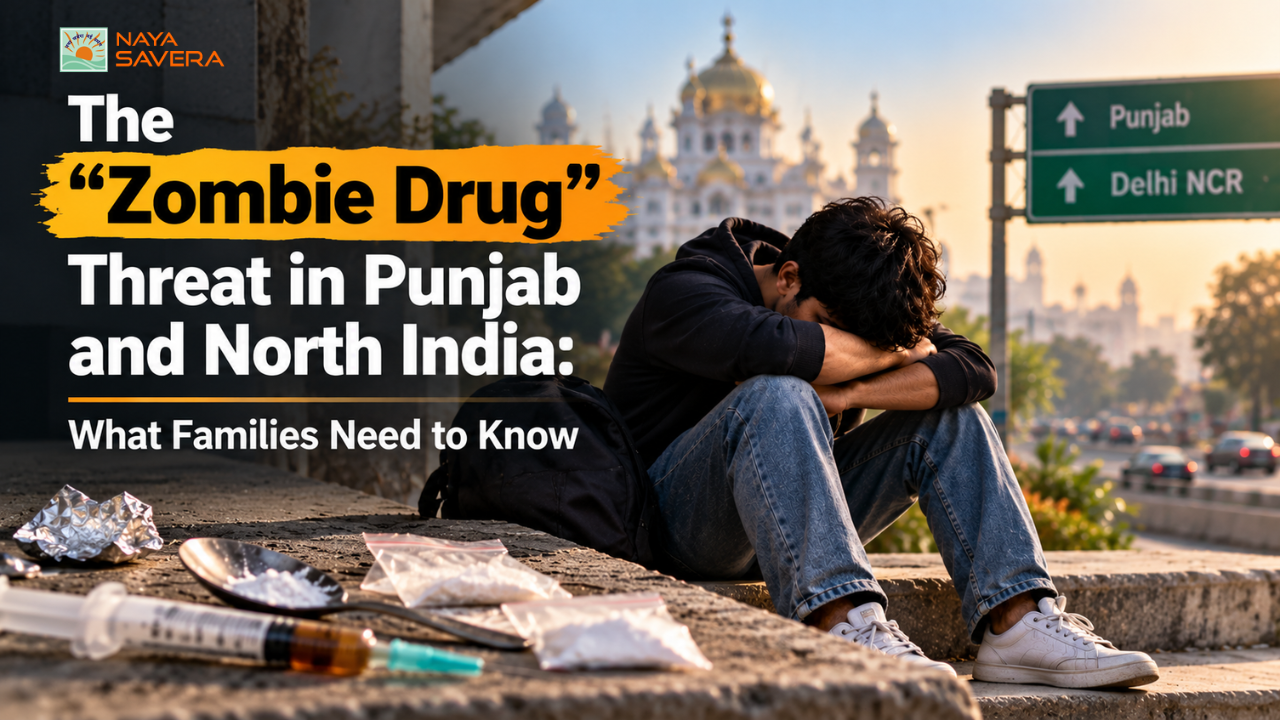

The phrase has moved from news tickers to family WhatsApp groups in a matter of months. Zombie drug. Parents in Ludhiana, Bathinda, Rohtak and Rohini are asking the same question in different words: is this a new substance, is it already in our city, and how would we know if our son or daughter had touched it. The honest answers are no, yes, and probably later than you think. This guide explains what the term actually refers to, why it is spreading through Punjab and into Delhi NCR, what it does to the body, and what a family should do the moment they suspect it.
What “Zombie Drug” Actually Means
The label comes from American reporting on xylazine, a veterinary sedative that drug suppliers in US cities began mixing into heroin and fentanyl because it is cheap and stretches the product. People under its influence stay on their feet but slumped, glassy eyed and unresponsive, which is where the “zombie” image came from. Xylazine also causes deep skin wounds at injection sites that refuse to heal, which made the pictures even more alarming.
In India the term has been attached to something families here already know by another name. Chitta is the street word for heroin across Punjab, and increasingly that heroin is cut with sedatives, tranquilisers and synthetic opioids that neither the seller nor the user can identify. The visible result of any strong opioid and sedative combination is identical whatever the exact mix: slowed breathing, drooping eyelids, loss of balance, and “nodding” in and out of awareness. That is not a new drug. It is the oldest effect in the book, made far more dangerous by whatever the supply chain adds this month.
So the useful question for a family is not “which zombie drug is this.” It is “this person is sedated to the point of danger, and what do I do now.” Both halves of that question are answered below.
Why It Is Spreading Now
Three things are driving the surge, and none of them is confined to Punjab.
The first is cost. Pure heroin is expensive. Cutting it with sedatives and cheap synthetic opioids lets a dealer sell more doses from the same quantity, and the buyer cannot tell the difference until the effect hits. The result is that the same “dose” a person used last month can be several times stronger or weaker this month, which is exactly how overdoses happen.
The second is the shift to injecting. Across the Malwa belt, and now in pockets of Delhi NCR, injectable use has overtaken smoking and snorting because it is cheaper per hit. Injection delivers the whole mix straight into the bloodstream, which makes a sedative heavy batch far more likely to stop someone’s breathing. We covered how injectable drug use is cutting short the lives of young athletes in the region, and the pattern described there is the same pattern families are now calling by a new name.
The third is the supply route. The networks that move chitta through Punjab’s Malwa districts feed the same product into Haryana, Ghaziabad, Noida and Delhi’s outer colonies. We have written about how synthetic drugs reach Delhi’s nightlife; the “zombie” effect families are reading about in Punjab is already visible in NCR, it simply does not have a trending hashtag yet.
What It Does to the Body
Families often focus on the visible stupor and miss the damage underneath it.
Breathing is the immediate danger. Opioids slow the part of the brain that drives breathing. Add a sedative and the slowing compounds. This is why a sedative heavy batch of chitta can kill a person who has used plain heroin for years without an overdose.
Infections and wounds follow injection. Shared or reused needles spread hepatitis and HIV. Sedative adulterants, xylazine in particular, cause tissue to die around injection sites, leaving open sores that spread and do not heal with ordinary care.
The kidneys and liver take a silent beating. Everything that enters the bloodstream is filtered by these organs, and unregulated chemical mixes accelerate damage that normally takes decades. Kidney failure in young men who inject is now common enough in Punjab that doctors no longer find it surprising.
Dependency forms fast. Synthetic opioid addiction progresses in months, not years. The alcohol dependency most Indian families are used to recognising builds slowly and gives everyone time to notice. This does not. A college student can go from first use to daily dependency within a single semester.
Warning Signs Families Usually Miss
Nobody goes from fine to a sedated stupor overnight. The drug addiction warning signs families usually look back on afterwards include pinpoint pupils and heavy eyelids at odd hours, sleeping through the day and restless at night, sudden weight loss and a lost appetite, nodding off mid conversation, long sleeves in warm weather, small foil or plastic packets, burnt spoons or bottle caps, money and small valuables disappearing, a new friend circle nobody has met, and a sharp withdrawal from family life.
Any three of these together in a young person deserve a direct conversation and a medical assessment for drug use, not another week of watching. The instinct to wait for certainty is the single most expensive mistake families make with synthetic drugs, because by the time certainty arrives the dependency is usually entrenched.
If You Find Someone in That State: A Medical Emergency
This section can save a life before any conversation about rehab happens.
A person heavily sedated by opioids or a sedative mix is at risk of an opioid overdose, with breathing slowing to the point of stopping. The signs are: unable to stay awake or stand, very small pupils, slow or shallow breathing, blue or grey lips or fingertips, gurgling or snoring sounds, and cold or clammy skin.
If you see this, call 112 or 108 for an ambulance immediately. Try to keep the person awake and talking. If they are unconscious but breathing, turn them on their side so they do not choke. Do not give food, water or a cold shower. If naloxone, the opioid reversal medicine, is available through a nearby government hospital or outreach programme, it can restore breathing within minutes. Stay with the person until help arrives. Do not leave them to “sleep it off,” and do not assume that because they have been this way before, they will come out of it this time.
The Stigma Problem, and Why It Hits Women Hardest
The “zombie” label does something subtle and damaging. It turns a person with a treatable medical condition into a creature. Families who hear their son or daughter described that way do not rush to a doctor. They hide the problem longer, which is precisely how a manageable dependency becomes an emergency.
The weight falls hardest on women. Addiction among women in India is dramatically under-reported, not because it is rare but because the cost of being seen is higher. A man seen intoxicated at a wedding is “that relative.” A woman seen in the same state becomes a cautionary tale for an entire district. We have written about why Indian men delay seeking help for addiction; for women, every one of those barriers is doubled. What families should know is that treatment works just as well for women as for men. The obstacle is never the medicine. It is the silence around getting to it, and a family that breaks that silence privately, early and without drama gives a daughter or a wife the same chance at recovery a son would get.
What Recovery From Synthetic Opioid Dependency Involves
The good news, and it is real, is that recovery is possible even after years of injecting. What it requires is proper medical care rather than willpower and locked doors.
Medically supervised detox comes first. Opioid withdrawal is intensely uncomfortable and, when sedatives are part of the mix, can be dangerous without supervision. A doctor manages the process with medication, daily monitoring and, where needed, treatment of the infections and wounds that injecting leaves behind. Detox alone, however, is not treatment. It is the doorway.
Structured rehabilitation follows: individual and group addiction counselling, a daily routine that rebuilds sleep, appetite and basic stability, education about how the substance has rewired the brain, and a written relapse prevention plan built around the person’s actual triggers. Family involvement runs through all of it, because the person returns to a home, a colony and a friend circle, and those need to change too. If you are unsure what this looks like in practice, our guide to what happens in the first 30 days at a rehab centre walks through it day by day.
How Naya Savera Treats Chitta and Synthetic Drug Dependency
Naya Savera is a non-profit nasha mukti kendra and rehabilitation centre with facilities in Delhi, Noida and Himachal Pradesh, providing alcohol and drug addiction treatment since 2008. For chitta and heroin de-addiction and synthetic opioid cases, treatment begins with a full medical assessment, including organ function and injection related infections, followed by supervised detox with daily doctor review. From there the person moves into structured counselling, group work and a daily recovery routine, with families involved from the first week. Every case is handled confidentially. Nobody is judged, labelled or turned into a lesson for others. The goal is the same for every family: reach treatment early, before the word “zombie” ever needs to be said about someone you love.
Frequently Asked Questions
What is the “zombie drug” people are talking about in Punjab?
It is a media label, borrowed from American reporting on xylazine, for the sedated, unsteady state produced by heroin mixed with sedatives and synthetic opioids. In Punjab the practical concern is adulterated chitta rather than one specific new substance.
Is the zombie drug already in Delhi NCR?
The same supply networks that move adulterated chitta through Punjab feed Haryana, Ghaziabad, Noida and Delhi’s outer colonies. The effect families in Punjab are reading about is already present in NCR, even if it is not yet being called by that name.
What should I do if I find someone in a sedated, unresponsive state?
Treat it as a possible overdose. Call 112 or 108, keep the person awake if possible, turn them on their side if unconscious, do not give food or water, and stay with them until help arrives.
Can chitta or synthetic opioid addiction be treated?
Yes. Medically supervised detox followed by structured rehabilitation and family involvement gives people a real path to recovery, including after years of use. The earlier treatment begins, the better the outcome.
Does Naya Savera keep treatment confidential?
Yes. Admission, treatment and family contact are handled privately for every patient.
If someone in your family is showing the signs described here, do not wait for a crisis to make the decision for you. Reach out to Naya Savera for a confidential conversation about the right next step.
Leave a Comment