

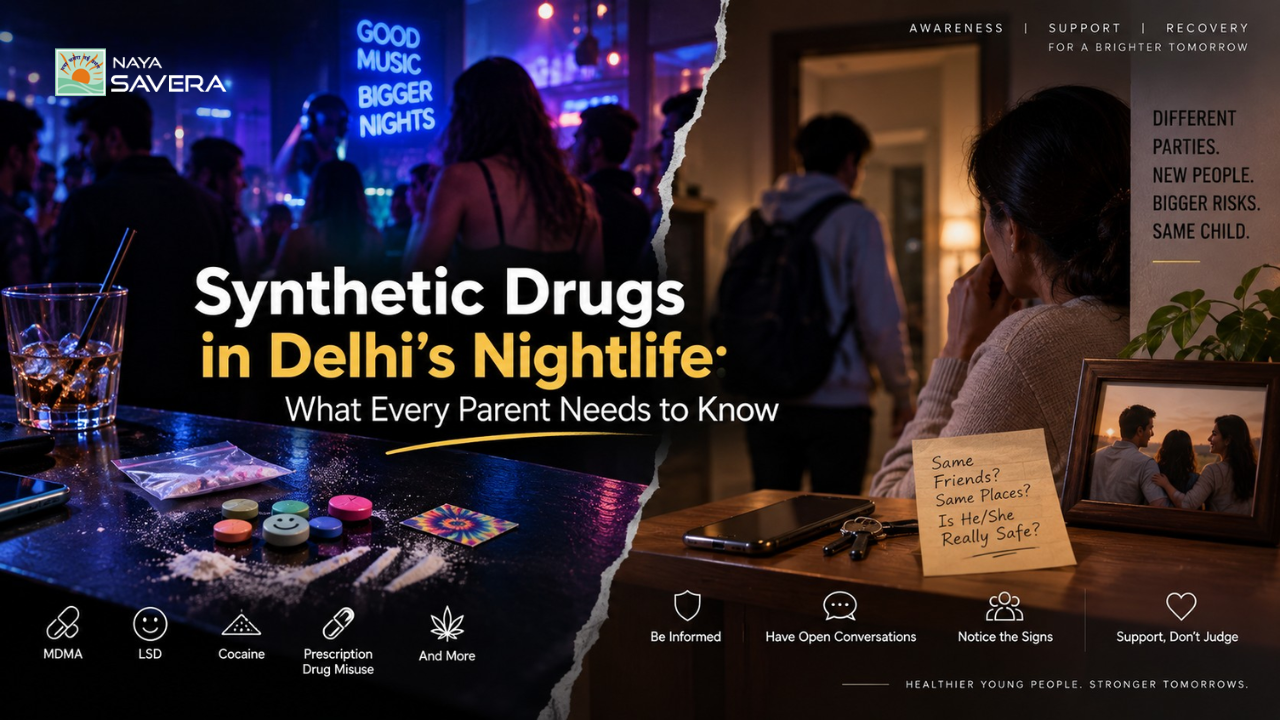

There is a shift happening quietly across Delhi NCR’s party and college scene, one that most parents have little visibility into. For years, the substances associated with youth drug use in India followed a fairly predictable pattern, cannabis, alcohol, the occasional cigarette experimented with in college. That pattern has changed considerably. Today, mental health professionals working across the capital region report that MDMA and LSD have become dominant substances in Delhi’s nightlife, alongside a steady rise in cocaine use and prescription drug misuse among college students and young professionals.
This is not a distant, abstract problem confined to news headlines about rave busts. It is happening in the same neighbourhoods where families live, send their children to college, and assume the biggest risk their teenager faces on a night out is staying out too late.
Why Synthetic Drug Use Is Rising Specifically in Delhi NCR
Several factors unique to the region are accelerating this shift. Delhi NCR has one of India’s largest concentrations of nightlife venues, private party circuits and college campuses, all clustered within a relatively small geographic area. This density creates exactly the kind of environment where synthetic drug use spreads quickly through peer networks, both in person and through coded references on social media that make coordination easier while staying under the radar of parents and authorities.
Social media itself plays a considerable role. What used to require a personal connection to access now often starts with an online group or a contact shared through a friend of a friend, lowering the barrier to first exposure significantly. Combine this with Delhi’s large, affluent student and young professional population, many of whom have disposable income and increasing independence from family oversight, and the conditions for experimentation multiply quickly.
A Different Kind of Danger Than Traditional Substances
One of the most important things for parents to understand is that synthetic drugs carry risks that differ meaningfully from more familiar substances like alcohol or cannabis. Pills sold as MDMA or ecstasy at parties are frequently not what they claim to be, street sold synthetic drugs are commonly mixed with unknown substances, sometimes far more potent or dangerous than what the buyer believes they are taking. This unpredictability means that even a single instance of use can, in rare but real cases, lead to a serious medical emergency.
Combining substances compounds this risk considerably. Mental health experts frequently note that anti anxiety medications like benzodiazepines, when mixed with alcohol or other substances at parties, create combinations that can be genuinely life threatening due to their combined effect on the central nervous system. Young people experimenting with these combinations rarely understand the danger involved, since the immediate experience feels manageable even when the underlying physiological risk is significant.
Recognising the Signs Parents Often Miss
Because synthetic drug use is typically episodic rather than daily, tied to specific nights out or parties, it often does not produce the same obvious pattern of decline that parents associate with more familiar forms of addiction. A student can perform reasonably well academically most of the time while still developing a dangerous relationship with weekend substance use.
Signs worth paying attention to include a noticeable shift in friend groups toward people the family knows little about, increasing secrecy around weekend plans, unusual sleep patterns particularly around weekends, unexplained mood changes ranging from unusual euphoria to flat exhaustion in the days following a night out, and financial requests that do not match visible spending. A young person who seems increasingly detached from family conversations, or who reacts with unusual defensiveness to ordinary questions about their social life, may also be signalling something worth a closer, gentler look.
Why This Requires a Different Conversation With Young People
Traditional anti drug messaging, built primarily around alcohol and cannabis, often does not resonate with a generation navigating a very different substance landscape. Fear based warnings that do not match what young people actually observe among their peers tend to lose credibility quickly, since many will know someone who has used a synthetic drug without an immediately visible negative consequence, which can create a false sense of safety around genuinely unpredictable substances.
A more effective approach focuses on specific, accurate information rather than blanket fear. Explaining honestly that street sold pills are frequently adulterated, that a person has no reliable way of knowing the actual dosage or composition of what they are taking, and that combining substances significantly increases risk, tends to land more credibly than vague warnings about drugs being universally dangerous. Parents and educators who approach this conversation with genuine curiosity rather than immediate judgment are also far more likely to keep a young person talking, which matters enormously if a situation does become serious.
Treatment Considerations Specific to Synthetic Drug Use
Addiction treatment for synthetic drug use often looks somewhat different from treatment for more established dependencies like alcohol, particularly because the pattern of use tends to be episodic rather than constant. This does not make it any less serious. Repeated exposure, even on an occasional basis, can lead to genuine psychological dependency, alongside real risk of a dangerous reaction from an unpredictable substance at any single instance of use.
Effective treatment for young people in this situation typically combines an honest, non judgmental clinical assessment, counselling that addresses the social and psychological factors driving continued use, whether that is peer pressure, anxiety, or a search for identity within a particular social scene, and family therapy that helps parents understand the situation without escalating into a purely punitive response, which often drives the behaviour further underground rather than resolving it.
Naya Savera has worked with young patients across Delhi NCR navigating exactly this pattern, including students connected to the intense academic environment around Gurugram’s corporate and college circuit, where social drinking and recreational substance use frequently intersect with high pressure academic and career environments. Our approach treats the underlying stress or social pattern driving the behaviour, not simply the substance use in isolation.
What Parents Can Do Right Now
If you suspect your child or a young family member may be experimenting with synthetic drugs, avoid an immediate confrontational approach, which often shuts down communication rather than opening it. Instead, create space for an honest conversation, ideally before a crisis forces the issue, focused on genuine concern rather than accusation.
Educate yourself on the actual substances circulating in your child’s social environment rather than relying on outdated assumptions about what youth drug use looks like. If you do discover clear evidence of use, professional guidance from a counsellor experienced in adolescent and young adult substance use is generally far more effective than attempting to manage the situation entirely within the family, particularly given how quickly synthetic drug situations can escalate.
Frequently Asked Questions
Are synthetic drugs like MDMA and LSD really becoming common in Delhi specifically?
Yes. Mental health professionals working across the region have noted a clear shift, with synthetic substances increasingly dominant in Delhi’s nightlife and college social scenes compared to more traditional substances.
Is occasional use at parties really cause for concern, or only regular use?
Even occasional use carries real risk with synthetic drugs specifically, since street sold substances are frequently adulterated or mislabelled, making the effects and dosage unpredictable on any single occasion, not just with regular use.
How is treatment for synthetic drug use different from treatment for alcohol addiction?
Treatment often needs to address episodic, socially driven use patterns rather than daily dependency, with a strong focus on the underlying social and psychological factors, such as peer pressure or anxiety, that drive continued use.
My child seems fine most of the time, could there still be a problem?
Yes. Synthetic drug use tied to weekend or party settings often does not produce the visible daily decline associated with other forms of addiction, which is part of what makes it easy for families to miss.
What should I do if I find evidence of synthetic drug use in my teenager or young adult child?
Approach the conversation with concern rather than immediate punishment, and consider reaching out to a professional counsellor experienced with young adult substance use, since early, informed intervention is significantly more effective than a purely disciplinary response.
A Trend Worth Taking Seriously
The shift toward synthetic drugs in Delhi’s nightlife and college scene represents a genuine change in the substance use landscape that many families are simply not prepared for. Recognizing this shift, and updating both the conversation and the response accordingly, gives parents a far better chance of catching a problem early, before an unpredictable substance leads to a genuinely dangerous outcome.
If you are concerned about a young person in your life, a confidential conversation with a professional treatment provider is a reasonable and responsible next step, not an overreaction. Naya Savera has supported families across Delhi, Noida and the wider NCR region since 2008, with an approach built specifically to understand the social and emotional context behind a young person’s substance use, not just the substance itself.
2 Comments