


“We raised both our sons the same way. Why him?”
Counsellors hear this question from parents almost every week. Two brothers grow up in the same house, go to the same school and drink at the same family weddings. One has a few drinks and stops. The other cannot stop at all. The family searches for a reason: bad friends, a weak mind, something they did wrong.
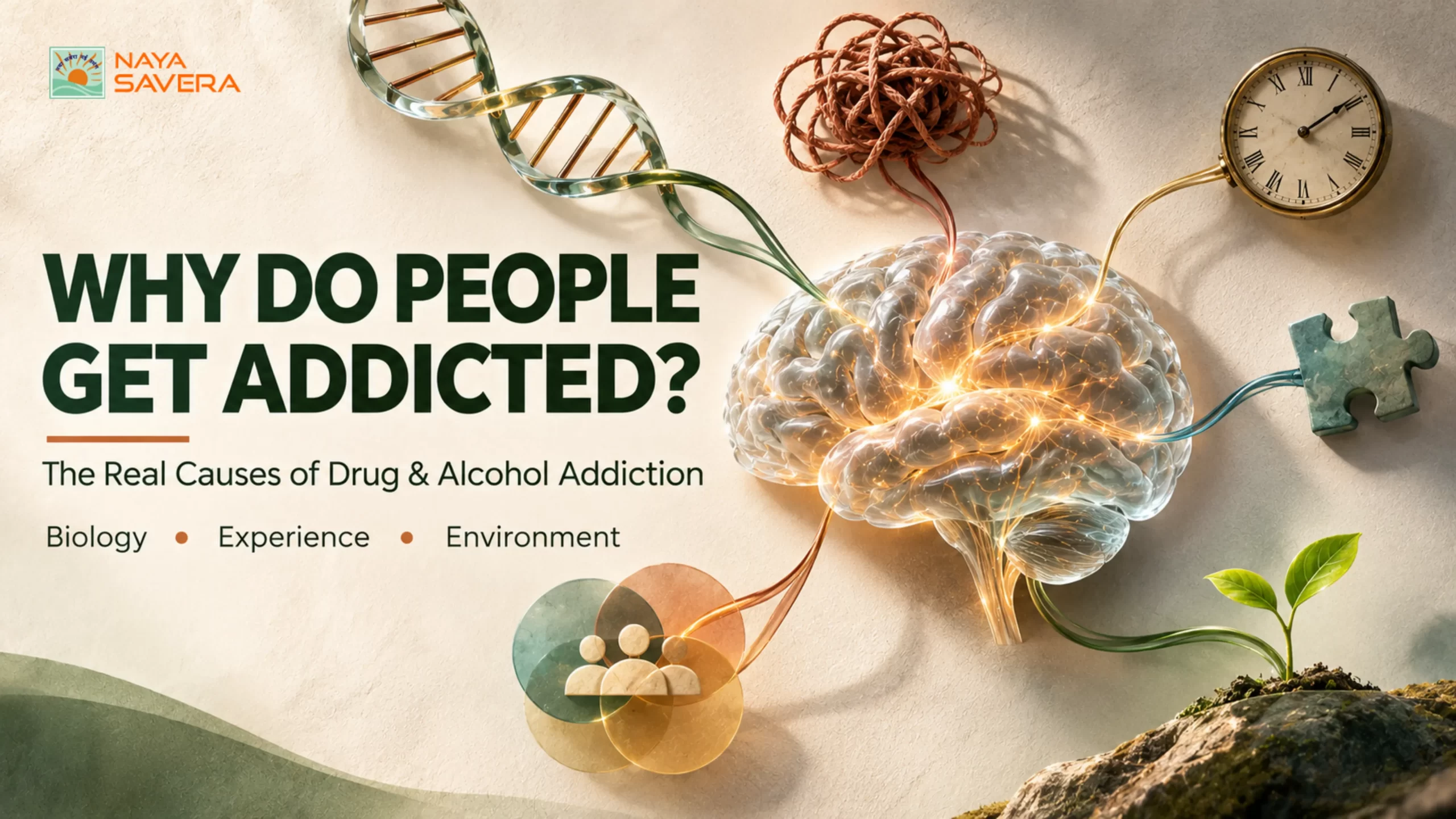
So why do people get addicted? The truth is more complicated, and more useful. Addiction rarely has one cause. It grows out of a mix of biology, life experience and environment, and understanding that mix is the first step towards treating it properly.
The Short Answer
The causes of drug addiction and the causes of alcohol addiction overlap heavily. The main causes of addiction are a combination of:
- genes and family history
- starting to drink or use drugs at a young age
- mental health problems such as anxiety, depression or trauma
- stress, loss and major life changes
- friends, culture and easy access to alcohol or drugs
- the type of substance itself
No single factor makes addiction certain. The more of these factors a person carries, the higher their risk.
Most People Who Drink Do Not Become Addicted
This point matters, because it shows addiction is not simply about the substance. India’s national survey on substance use, published in 2019, found that about 14.6 percent of Indians aged 10 to 75, roughly 16 crore people, use alcohol. About 2.7 percent, around 2.9 crore people, were estimated to have alcohol dependence.
In other words, most people who drink never become dependent. Something makes some people far more vulnerable than others. That something is what this article is about.
What Happens in the Brain
Alcohol and drugs act on the brain’s reward system, the same system that makes food, friendship and achievement feel good. They release a surge of dopamine, much bigger and faster than everyday pleasures.
With repeated use, the brain adapts:
- It needs more of the substance to feel the same effect.
- Normal pleasures start to feel flat.
- The parts of the brain that control judgement and self-control weaken their grip.
- Cravings and withdrawal push the person to keep using, even when they want to stop.
This is why addiction is described as a brain condition rather than a moral failing. The first drink or the first joint is a choice. After the brain has changed, stopping is no longer a simple matter of deciding to.
The Main Causes and Risk Factors
Doctors group the risk factors for addiction into biology, mental health and environment. Here is how each one works.
1. Genes and family history
So, is addiction genetic? Partly. Addiction runs in families. Researchers estimate that genes account for roughly 40 to 60 percent of a person’s vulnerability to addiction. A son whose father or grandfather drank heavily is at higher risk himself, partly through inherited biology and partly through what he saw growing up.
Family history is a risk, not a sentence. Many people with alcoholic parents never develop a problem, especially when they know their risk and make choices with it in mind.
2. Starting young
The teenage brain is still developing until the mid-twenties, and it is especially sensitive to alcohol and drugs. US research has found that people who start drinking before the age of 15 are around four times more likely to develop alcohol dependence than those who wait until 21.
In many Indian homes, the first sip happens at a wedding, a festival or a family party, often with an adult’s encouragement. The first joint often comes in a hostel or college group. The earlier it starts, the deeper the habit can set. Our article on cannabis addiction among college students shows how quickly “just experimenting” can become daily use.
3. Mental health problems
Anxiety, depression, ADHD, bipolar disorder and post-traumatic stress all raise the risk of addiction. Many people first drink or use drugs to quiet feelings they cannot name or manage, a pattern often called self-medication. It works for a while, then makes everything worse.
When addiction and a mental health condition exist together, both need treatment at the same time. The reasons are explained in dual diagnosis: depression, anxiety and addiction.
4. Stress, loss and big life changes
Job loss, business failure, debt, exam pressure, a breakup, the death of a parent, moving to a new city for work: these are moments when people reach for something to cope. A few drinks to sleep after a stressful day can slowly become a bottle every night.
Working professionals are especially good at hiding this. They keep performing at work while the drinking grows, a pattern described in high functioning alcohol addiction.
5. A difficult childhood
Growing up with violence at home, a parent who drank heavily, neglect, bullying or other painful experiences leaves a lasting mark. Children who go through these experiences are more likely to struggle with addiction as adults, often because they never learned safe ways to handle difficult emotions. This is no one’s fault, but it is important to recognise, because healing those old wounds is part of recovery.
6. Friends, culture and availability
People drink and use what is around them, and peer pressure is real at every age. Use becomes more likely with:
- a friend group that smokes up every weekend
- a workplace where deals are closed over drinks
- a family where heavy drinking is treated as normal
- a neighbourhood where drugs are easy to find
Indian social life adds its own pressure. Refusing a drink at a wedding can feel rude, and the relative who drinks too much is often laughed off rather than helped. We looked at this in wedding season and alcohol.
7. The substance itself
Some substances hook people faster than others. Heroin and other opioids cause physical dependence quickly. Stimulants with a short high, such as cocaine and some synthetic drugs, push people into repeated use within a single night. How a drug is taken matters too: smoking and injecting reach the brain faster than swallowing, which strengthens the addictive pull.
8. Personality and coping style
People who are impulsive, who seek thrills, who struggle with low self-esteem or who find it hard to manage anger or sadness tend to be at higher risk. These traits are not flaws. They simply mean the person benefits from learning other ways to cope.
Risk Factors and Protective Factors at a Glance
Risk is only half the picture. Some things make addiction less likely, even for someone with risk factors.
| Raises the risk | Lowers the risk |
|---|---|
| Family history of addiction | Knowing about family risk and talking openly about it |
| First drink or drug use in the early teens | Delaying first use as long as possible |
| Untreated anxiety, depression or ADHD | Early diagnosis and treatment of mental health problems |
| Violence, neglect or heavy drinking at home | A stable, warm relationship with at least one parent |
| Friends who drink or use drugs heavily | Friends and activities that do not revolve around substances |
| Chronic stress with no outlet | Healthy coping habits like sport, exercise and hobbies |
| Easy access to alcohol or drugs | Clear family rules and supervision during the teenage years |
Myths About Why People Get Addicted
“He is just weak.” Addiction affects people with strong personalities, successful careers and strict values. Willpower does not protect anyone from the changes alcohol and drugs make in the brain.
“It is only because of bad company.” Friends play a role, but many people in the same friend group never become addicted. Biology, mental health and life history matter just as much.
“It must be bad parenting.” Loving, careful families also face addiction. Blame helps no one and often delays treatment.
“If he really loved us, he would stop.” Love does not switch off a changed brain. Most people with addiction want to stop and feel deep shame that they cannot.
Why Knowing the Cause Changes Treatment
Treating addiction without asking why it started is like mopping the floor without fixing the leak. Good addiction treatment looks at the whole person:
- A person who drank to manage anxiety needs anxiety treatment and new coping skills.
- A person who used drugs to escape trauma needs safe, careful work on that trauma.
- A person whose friend group revolves around drugs needs a plan for a new social life.
- A person with a strong family history needs to understand that risk for life.
This is why counselling, cognitive behaviour therapy and family counselling sit at the centre of recovery, alongside medical care. Detox clears the body. Understanding the causes is what helps a person stay clean.
Can Families Lower the Risk for Younger Children?
If one family member already struggles with addiction, younger siblings and children carry a higher risk. Families can lower it:
- Talk openly about the family history in an age-appropriate way, without shame
- Delay any alcohol use for as long as possible, including the “harmless sip” at functions
- Watch for anxiety, sadness or attention problems and get help early
- Keep alcohol and medicines locked away
- Encourage sport, hobbies and friendships that give natural highs
- Model healthy ways of handling stress at home
If you are already worried that someone is using, the checklist in how to tell if someone is on drugs will help you know what to look for.
Finding the “Why” at Naya Savera
At Naya Savera, every admission starts with a detailed health and psychological assessment that looks beyond the drink or the drug. It covers family history, childhood, mental health, stress and the circumstances that kept the addiction going. Our counsellors and clinical psychologist then build treatment around those answers. They use cognitive behaviour therapy, family and marital therapy and stress management, alongside the 12 Steps and medical care.
Naya Savera is a non-profit de addiction centre and nasha mukti kendra that has worked with families since 2008. We treat both alcohol addiction and drug addiction at our rehabilitation centre in Delhi, our nasha mukti kendra in Noida and our centre in Palampur, Himachal Pradesh.
Frequently Asked Questions
What are the main causes of drug and alcohol addiction?
Addiction usually comes from a mix of factors:
- genes and family history
- starting young
- mental health problems
- stress and trauma
- friends and culture
- easy access
- the type of substance used
The more risk factors a person has, the higher the chance of addiction.
Is addiction genetic?
Partly. Researchers estimate that genes account for roughly 40 to 60 percent of a person’s vulnerability to addiction. A family history raises the risk, but it does not make addiction certain.
Why do some people get addicted and others do not?
Because risk depends on many things at once. Two people can drink the same amount, but differences in genes, mental health, life experiences, stress and the age they started can lead to very different outcomes.
Can stress cause addiction?
Stress on its own does not cause addiction, but it is a major trigger. People under long-term stress often use alcohol or drugs to cope. That coping habit can grow into dependence, especially when other risk factors are present.
Is addiction a choice?
The first use is usually a choice. Over time, alcohol and drugs change the brain’s reward and self-control systems, so continued use becomes driven by cravings and withdrawal rather than free choice. That is why addiction needs treatment, not blame.
Understanding why addiction started is where real recovery begins. To speak with the Naya Savera team in Delhi or Noida, call 98732 90300 or email info@nayasavera.org.
1 Comment