

How big is the problem, really? Families dealing with addiction often feel they are the only ones. The numbers say otherwise. Crores of Indians drink or use drugs, lakhs need help, and only a small fraction ever receive treatment.
This page brings together the most reliable figures on drug addiction in India and alcohol addiction in India, drawn from national surveys, Parliament replies, the National Crime Records Bureau and the World Health Organization. These drug addiction statistics are listed with their sources, so each figure can be checked.
A note before the numbers: India’s most detailed national survey on substance use was carried out by NDDTC, AIIMS New Delhi, for the Ministry of Social Justice and Empowerment, and published in 2019. A new national survey, NDUS 2025, began in July 2025, and its results will update many of these figures when released.
Key Numbers at a Glance
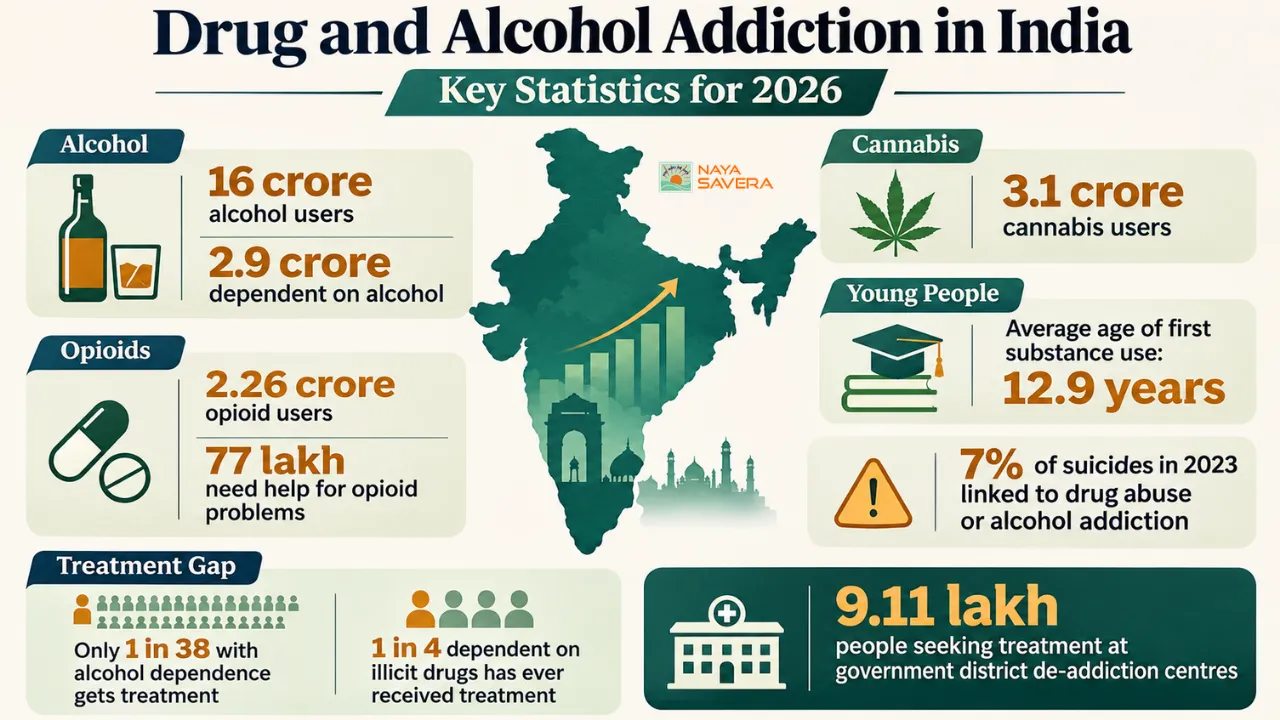
- 16 crore Indians aged 10 to 75 use alcohol, and about 2.9 crore are dependent on it
- 3.1 crore use cannabis, and 2.26 crore use opioids such as heroin, opium or pharmaceutical opioids
- About 77 lakh people need help for opioid problems
- Only 1 in 38 people with alcohol dependence report getting any treatment
- 1 in 4 people dependent on illicit drugs has ever received treatment
- 7 percent of suicides in India in 2023 were attributed to drug abuse or alcohol addiction
- The average age of first substance use among school students surveyed was 12.9 years
- More than 9.11 lakh people are currently seeking treatment at government district de-addiction centres
Alcohol Consumption in India
Alcohol is by far the most commonly used substance in the country, and alcohol consumption in India is heavily concentrated among men.
| Measure | Figure |
|---|---|
| Current alcohol users (age 10 to 75) | 14.6% of the population, about 16 crore people |
| People with alcohol dependence | 2.7%, about 2.9 crore people |
| People with harmful or dependent alcohol use | 5.2%, more than 5.7 crore people |
| Drinkers who drink in a dependent pattern | About 19%, nearly 1 in 5 |
| Alcohol use among men vs women | 27.3% of men vs 1.6% of women |
| Ratio of male to female drinkers | 17 men for every 1 woman |
Source: Magnitude of Substance Use in India, 2019
The National Family Health Survey (NFHS-5) found a similar gap: about 22 percent of men aged 15 to 49 drink alcohol, compared with 1 percent of women. Among men who drink, 15 percent drink almost every day.
States with the highest alcohol use: Chhattisgarh, Tripura, Punjab, Arunachal Pradesh and Goa. In Tripura, Andhra Pradesh, Punjab, Chhattisgarh and Arunachal Pradesh, alcohol use disorders affect more than 10 percent of the population.
What the numbers suggest is that most people who drink do not become dependent, but nearly one in five do. Why some people are far more vulnerable than others is explained in the real causes of drug and alcohol addiction.
Cannabis Use in India
Here is what the national survey found on cannabis use in India.
| Measure | Figure |
|---|---|
| Cannabis users in the past year | 2.8%, about 3.1 crore people |
| Bhang users | About 2%, around 2.2 crore |
| Ganja and charas users | About 1.2%, around 1.3 crore |
| People with cannabis dependence | 0.25%, about 25 lakh |
| People with harmful or dependent use | 0.66%, about 72 lakh |
Source: Magnitude of Substance Use in India, 2019
One finding stands out for families. About 1 in 16 bhang users was dependent on cannabis, but the figure was 1 in 7 for ganja and charas users. Smoked cannabis carries a much higher risk of dependence.
States with the highest cannabis use: Uttar Pradesh, Punjab, Sikkim, Chhattisgarh and Delhi. The risks for young people are covered in cannabis addiction among college students.
Opioid Use in India
Here is what the survey found on opioid use in India, which includes heroin, opium and pharmaceutical opioids.
| Measure | Figure |
|---|---|
| Opioid users | 2.1%, about 2.26 crore people |
| Heroin users | 1.14% |
| Pharmaceutical opioid users | 0.96% |
| Opium users | 0.52% |
| People needing help for opioid problems | 0.7%, about 77 lakh |
| People with opioid dependence | 0.26%, about 28 lakh |
Source: Magnitude of Substance Use in India, 2019
The survey found that heroin had overtaken opium as the most common opioid. Sikkim, Arunachal Pradesh, Nagaland, Manipur and Mizoram have the highest prevalence. But seven states, Uttar Pradesh, Punjab, Haryana, Maharashtra, Madhya Pradesh, Delhi and Andhra Pradesh, together account for more than half of all people with opioid use disorders in India. The warning signs are explained in smack and heroin addiction.
Sedatives, Inhalants and Injecting Drug Use
- About 1.18 crore Indians (1.08%) are current users of sedatives such as sleeping pills and anxiety medicines, used without a prescription or beyond it
- About 77 lakh people (0.7%) use inhalants such as whitener, glue and petrol
- Inhalant use is higher among children and adolescents (1.17%) than adults (0.58%)
- An estimated 4.6 lakh children and 18 lakh adults need help for inhalant use
- Uttar Pradesh, Madhya Pradesh, Maharashtra, Delhi and Haryana have the highest numbers of children needing help for inhalants
- India has an estimated 8.5 lakh people who inject drugs, with high numbers in states including Uttar Pradesh, Punjab, Delhi and Haryana
Source: Magnitude of Substance Use in India, 2019
Children and Teenagers
In a written reply to the Lok Sabha in July 2026, the Ministry of Social Justice and Empowerment shared estimates from the national survey for children aged 10 to 17:
| Substance | Estimated users aged 10 to 17 |
|---|---|
| Opioids | 40 lakh |
| Alcohol | 30 lakh |
| Inhalants | 30 lakh |
| Cannabis | 20 lakh |
A separate AIIMS-led study of 5,920 school students in 10 cities, including Delhi, published in 2025, found:
- 15.1% of students had used a psychoactive substance at least once
- 10.3% had used one in the past year
- The average age of first use was 12.9 years, and just 11.3 years for inhalants
- Use was higher among boys and rose with each grade
For parents, the message is clear: conversations about drugs need to start well before college. The warning signs to watch for are listed in how to tell if someone is on drugs.
The Treatment Gap
This is perhaps the most important set of numbers on this page. Most Indians with addiction never get help.
| Group | Ever received any treatment | Received in-patient treatment |
|---|---|---|
| People with alcohol dependence | 1 in 38 | 1 in 180 |
| People dependent on illicit drugs | 1 in 4 | 1 in 20 |
Source: Magnitude of Substance Use in India, 2019
The survey itself concluded that the reach of national treatment programmes was “grossly inadequate”. The treatment gap is not a sign that addiction cannot be treated. It reflects stigma, lack of awareness, cost, distance and the belief, common in Indian families, that the problem can be handled at home.
Deaths and Harm
- Worldwide, alcohol caused an estimated 2.6 million deaths in 2019, about 4.7 percent of all deaths, and psychoactive drugs caused another 0.6 million (WHO, 2024)
- Men accounted for 2 million of those alcohol deaths and 0.4 million of the drug deaths
- In India, 1,71,418 suicides were recorded in 2023, and 7 percent, roughly 12,000 deaths, were attributed to drug abuse or alcohol addiction (NCRB, 2023)
- In 2026, methanol-laced spurious liquor was blamed for at least 14 deaths in Pune, 13 in Bhavnagar and 19 in Nagaland. The warning signs are covered in alcohol poisoning and hooch
Delhi NCR Snapshot
| Indicator | What the data shows |
|---|---|
| Cannabis | Delhi is among the five states and UTs with the highest cannabis use |
| Opioids | Delhi is among seven states that together hold more than half of India’s opioid use disorders |
| Children and inhalants | Delhi is among the top five for children needing help with inhalant use |
| Injecting drug use | Delhi is among the states with high estimated numbers of people who inject drugs |
| Enforcement, January to April 2026 | 1,129 NDPS cases and 1,397 arrests by Delhi Police |
| Policy goal | A drug-free Delhi by 2027, with a dedicated Anti Narcotics Task Force police station operational since September 2026 |
What these enforcement steps mean for families is discussed in drug-free Delhi by 2027.
The Government Response
Under the Nasha Mukt Bharat Abhiyaan, run by the Ministry of Social Justice and Empowerment:
- More than 9.11 lakh people are seeking treatment at 198 district de-addiction centres (November 2026)
- Awareness activities have reached more than 35.88 crore people (November 2026)
- More than 28.29 lakh people have been treated and rehabilitated under the campaign, according to a Lok Sabha reply in July 2026
- National helplines include 14446 for de-addiction support, 1933 (MANAS) to report drug trafficking, and 14416 (Tele-MANAS) for mental health
What These Numbers Mean for Families
Behind every statistic is a household. Read together, the figures point to five simple truths:
- Addiction is common. If someone in your family is struggling, you are far from the only one.
- It affects men most. For every woman who drinks, 17 men do, and men account for most alcohol and drug deaths.
- It starts young. First use often happens before the age of 13, so prevention has to begin at home and at school.
- Most people never get help. Only 1 in 38 people with alcohol dependence report any treatment at all.
- Treatment works, but it takes time. Most people need at least three months of structured care, as explained in how long rehab takes.
Closing the Gap, One Family at a Time
Every person who reaches treatment is one more person taken out of the treatment gap. Naya Savera is a non-profit nasha mukti kendra, registered under the Indian Trust Act, that has worked with families since 2008. It treats alcohol and drug addiction through medical assessment and detox, counselling, the 12 Steps and family counselling. Families can reach our rehabilitation centre in Delhi or our de addiction centre in Noida.
Frequently Asked Questions
How many people are addicted to alcohol in India?
According to the national survey published in 2019, about 16 crore Indians aged 10 to 75 use alcohol. About 2.9 crore are dependent on it, and more than 5.7 crore have harmful or dependent alcohol use.
Which drug is most commonly used in India?
After alcohol, cannabis is the most commonly used substance, with about 3.1 crore users, followed by opioids with about 2.26 crore users. Among opioids, heroin is now the most common.
Which states have the highest drug use in India?
Cannabis use is highest in Uttar Pradesh, Punjab, Sikkim, Chhattisgarh and Delhi. Opioid use is highest in Sikkim, Arunachal Pradesh, Nagaland, Manipur and Mizoram. Alcohol use is highest in Chhattisgarh, Tripura, Punjab, Arunachal Pradesh and Goa.
How many people with addiction get treatment in India?
Very few. Only about 1 in 38 people with alcohol dependence report getting any treatment, and about 1 in 4 people dependent on illicit drugs have ever been treated.
Is there a newer national survey on drug use in India?
Yes. NDUS 2025, a new national survey by the Ministry of Social Justice and Empowerment with NDDTC, AIIMS, began in July 2025. Its results will update the figures from the 2019 report once released.
Sources
- Magnitude of Substance Use in India, Ministry of Social Justice and Empowerment and NDDTC, AIIMS New Delhi, 2019
- Lok Sabha written reply, Ministry of Social Justice and Empowerment, July 2026
- Dhawan A. et al., substance use among school students, The National Medical Journal of India, 2025
- National Family Health Survey (NFHS-5)
- Accidental Deaths and Suicides in India 2023, National Crime Records Bureau
- WHO Global Status Report on Alcohol and Health and Treatment of Substance Use Disorders, 2024
- Ministry of Social Justice and Empowerment update on Nasha Mukt Bharat Abhiyaan, November 2026
- Delhi Police and Lieutenant Governor’s office statements, 2026
For help with alcohol or drug addiction in Delhi NCR, call Naya Savera on 98732 90300.
Leave a Comment