

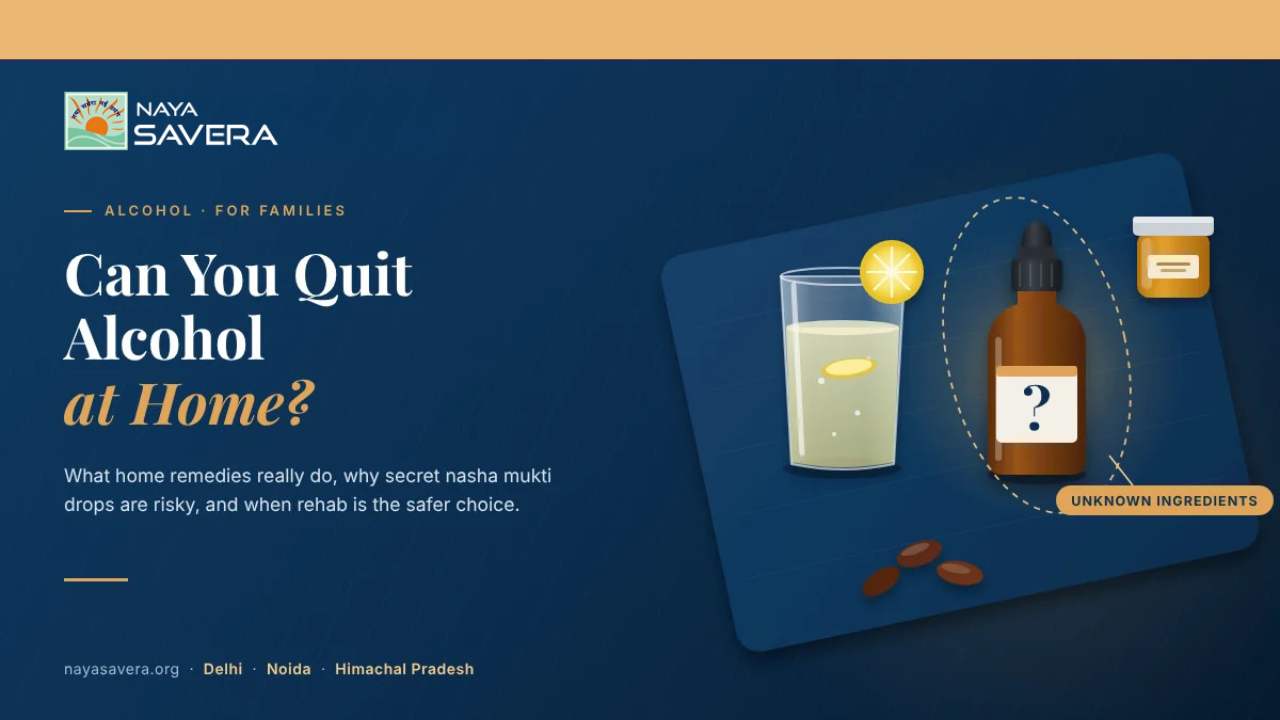

Type “sharab chhudane ke upay” into any search bar and you will find thousands of answers. Lemon water in the morning. Dates and honey. Bitter gourd juice. A powder to mix into his tea without telling him. A bottle of “nasha mukti drops” with a money back guarantee. WhatsApp forwards promise that he will stop drinking within a week.
It is easy to see why families try these first. Home feels safer, cheaper and more private than a rehab centre, and nobody in the neighbourhood needs to know. Some people can cut down or stop at home. But for many others, trying to quit alcohol at home is often ineffective and sometimes dangerous. This guide explains:
- who can safely try
- what the popular home remedies really do
- why secret medicines are risky
- the signs that it is time for professional help
First, Find Out Where He Stands
Not every drinking problem is the same. Someone who drinks too much at weekend parties is in a very different place from someone who needs a drink every morning to stop his hands shaking.
The World Health Organization’s AUDIT test is a simple ten question screening test used by doctors around the world. It asks:
- how often and how much a person drinks
- whether they have tried and failed to cut down
- whether they need a drink in the morning
- whether drinking has caused guilt, injury or worry to others
Roughly speaking, the score works like this:
- A low score suggests lower risk drinking.
- A score of 8 or more suggests hazardous drinking that is worth cutting down.
- A score of 20 or more suggests possible alcohol dependence, which usually needs professional assessment and treatment.
The AUDIT questions are freely available online. Answering them truthfully, ideally together with a doctor, gives a much clearer picture than guesswork.
The Hidden Danger: Stopping Suddenly
This is the most important part of this guide. For a person who has been drinking heavily every day for months or years, stopping suddenly can be medically dangerous.
The brain adapts to constant alcohol. When it is suddenly removed, the nervous system goes into overdrive. Alcohol withdrawal symptoms usually begin within 6 to 24 hours of the last drink:
- Shaking hands, sweating and a racing heart
- Anxiety, irritability and sleeplessness
- Nausea, vomiting and loss of appetite
- In more severe cases, seizures, usually within the first two days
- In the most severe cases, delirium tremens: confusion, hallucinations, fever and high blood pressure. It typically starts two to four days after the last drink and can be fatal without treatment.
Families sometimes lock a heavy drinker in a room to “sweat it out”, or hide every bottle at once. Without medical support, this can turn into an emergency. See a doctor before stopping if the person:
- drinks heavily every day
- has had shakes or seizures when stopping before
- has other health problems
Our guide to alcohol detox under medical supervision explains what a safe detox involves.
If someone develops seizures, severe confusion or hallucinations while withdrawing, call 112 or go to the nearest hospital immediately.
“Nasha Chhudane Ki Dawa”: Why Secret Remedies Are Risky
Many products are sold online and through advertisements as nasha mukti drops or powders. They promise to stop drinking without the drinker’s knowledge, simply by mixing them into food or tea. These products carry real risks.
Nobody knows what is in them. Many are not properly regulated, their ingredients are not clearly disclosed, and their claims are rarely tested.
Medicines that react with alcohol need consent. Some genuine prescription medicines, such as disulfiram, work by causing a severe reaction if the person drinks: flushing, vomiting, a pounding heart, breathlessness and a drop in blood pressure. A strong reaction can be dangerous. That is why doctors prescribe such medicines only to patients who know they are taking them, have agreed to it and are under medical supervision. Giving any medicine like this secretly puts the person at serious risk.
It destroys trust. When the person finds out, and they usually do, the betrayal makes them far less likely to accept real help later.
It treats the drink, not the person. Even if a product stopped the drinking for a while, it does nothing about the stress, habits, emotions and relationships that drove it.
What About Home Remedies Like Lemon, Honey and Dates?
Popular home remedies include lemon water, honey, dates, bitter gourd juice, amla, carrot juice and various herbs. Eating well and drinking plenty of water do help the body recover. Heavy drinkers are often dehydrated and short of vitamins, especially thiamine, so good nutrition matters.
But no food, juice or herb can cure alcohol addiction on its own. Addiction is not a vitamin deficiency. It is a change in how the brain handles reward, stress and habit, and it needs a change in behaviour, support and often medical care.
Traditional approaches such as Ayurveda and yoga can play a useful role in recovery when they are part of a supervised treatment programme, alongside medical care and counselling. The problem is not tradition. The problem is relying on a remedy alone and waiting while the drinking gets worse.
Who Can Try to Cut Down or Stop at Home?
Quitting at home may be reasonable for someone who:
- Drinks occasionally or moderately rather than heavily every day
- Has never had shakes, sweating, seizures or hallucinations when stopping
- Has no serious liver, heart or other health problems
- Is not also using drugs or sleeping pills
- Has no depression, anxiety or other mental health condition that drinking is masking
- Has a supportive home and wants to stop
Even then, a check up with a doctor and a simple liver function test is a good idea.
What Actually Helps When Quitting at Home
If home is a safe option, these steps show how to stop drinking with a better chance of success:
- Set a date and tell the people closest to you, so you are not doing it in secret.
- Clear the house of all alcohol before that date.
- Change the evening routine. For most drinkers, the hardest hours are the ones when they used to drink. Fill them with a walk, the gym, a meal with family or a hobby.
- Know your triggers, such as stress at work, certain friends, payday or arguments, and plan what you will do instead.
- Avoid drinking situations for the first few months, including parties and weddings where pressure to drink is high.
- Eat regular meals, drink water and sleep properly, because hunger, thirst and tiredness all feel like cravings.
- Get support. Alcoholics Anonymous meetings are free and run across Delhi NCR. Our guide to how the 12 Steps work explains what to expect.
- Count the wins. Track sober days and notice what improves: sleep, money, mood, relationships.
Signs That Home Is Not Enough
Home is usually not the right place to quit if any of these apply:
- Drinking every day, often from the morning
- Shaking, sweating or feeling ill without a drink
- Seizures, confusion or hallucinations during past attempts to stop
- Several failed attempts to quit at home
- Liver problems, jaundice, stomach bleeding or other serious health effects
- Using drugs or pills along with alcohol
- Depression, anxiety, anger or talk of hopelessness
- Violence, debt or work problems linked to drinking
- A home where alcohol is easy to get or conflict is constant
If several of these sound familiar, a de addiction centre offers safety and structure that home cannot. If the person refuses to consider it, our guide on how to convince someone to go to rehab may help.
What Rehab Offers That Home Cannot
A residential rehabilitation centre adds several things that are very hard to recreate at home:
- Medically supervised detox, so withdrawal is managed safely
- Distance from drinking friends, easy access and daily stress
- Structure, with a routine that fills the hours drinking used to take
- Counselling, including cognitive behaviour therapy to manage cravings and triggers
- Family counselling, to repair trust and prepare the family for the person’s return
- Time to heal and practise new habits before facing real life again
How long that takes depends on the person. Our guide on how long rehab takes explains why most people need at least three months. Our piece on what happens in the first 30 days at a rehab centre describes the early weeks.
If You Are Supporting Someone at Home
Families play a huge part, whether the person is quitting at home or after rehab:
- Keep the house free of alcohol, including for guests, at least in the early months
- Praise effort and sober days rather than only pointing out slips
- Do not offer “just one drink” at functions, and help him leave early if needed
- Watch for withdrawal symptoms in the first few days and call a doctor if they appear
- Look after yourself too, because living with someone’s drinking is exhausting
If you are a wife in this situation, our guide on when your husband drinks every day offers practical support.
How Naya Savera Helps
Naya Savera is a non-profit nasha mukti kendra registered under the Indian Trust Act, working with families since 2008. We run:
- a rehabilitation centre in Delhi
- a nasha mukti kendra in Noida
- a centre in Palampur, Himachal Pradesh
Treatment moves from health assessment and detox through primary care, secondary care and aftercare. Our programme combines the Narcotics Anonymous 12 Steps and a therapeutic community with clinical psychiatry, Ayurveda and yoga, along with 24/7 medical and psychological support. Our counsellors and clinical psychologist provide cognitive behaviour therapy, family and marital therapy and stress management. Families take part through monthly counselling and home visits, and every person leaves with a relapse prevention plan and regular follow ups.
Frequently Asked Questions
Can I quit alcohol at home?
Some people can, especially those who drink moderately, have never had withdrawal symptoms and have no serious health problems. People who drink heavily every day should see a doctor before stopping, because sudden withdrawal can cause seizures and other dangerous complications.
Is it dangerous to stop drinking suddenly?
For heavy daily drinkers, yes. Alcohol withdrawal can cause shaking, sweating and anxiety, and in severe cases seizures and delirium tremens, which can be fatal without treatment. A medically supervised detox manages these risks safely.
Do nasha mukti drops and powders work?
There is little reliable evidence that they do, and many have undisclosed ingredients. Giving any medicine secretly is risky, especially one that reacts with alcohol, and it damages trust. Real recovery needs the person’s own involvement.
Which home remedies help with quitting alcohol?
Good food, plenty of water, proper sleep, exercise and a supportive home all help the body and mind recover. But no food, juice or herb can cure alcohol addiction on its own. Remedies help most as part of a wider plan that includes support and, where needed, medical care.
When should someone go to rehab instead of quitting at home?
Professional treatment is much safer and more effective if the person:
- drinks every day
- has had withdrawal symptoms or failed attempts to quit before
- has health problems
- uses other drugs
- has depression or anxiety
- has seen drinking lead to violence, debt or work problems
If you are unsure whether home is safe for someone you love, reach out to Naya Savera for a confidential conversation before you try anything else.
1 Comment